Our Kansas wheat crop is threatened each year by three wheat rusts: stripe rust, leaf rust, and stem rust. These rusts can usually be distinguished based on their color and the pattern of infection on wheat leaves and stems (Figure 1). Over the last several years, stripe rust has been the biggest concern for the state. This year, it appears we should pay closer attention to leaf rust, which has built to high levels in Texas and may have overwintered (survived the winter) in parts of Kansas. So far, dry weather across Kansas is likely slowing down our risk. If conditions turn warm and wet, the risk may increase.
Now is a good time to remind ourselves how our varieties respond to leaf rust (https://bookstore.ksre.ksu.edu/pubs/kansas-wheat-variety-guide-2025_MF991.pdf). Varieties rated 5 or higher should be scouted more closely as they enter the later stages of development. Fungicides are generally not recommended until rusts have been reported in the state or are active in or near a field. It will be critical to continue scouting for these rusts in Kansas over the next several weeks to fully understand the risk. In this article, we will walk through some of the factors to consider for this season.
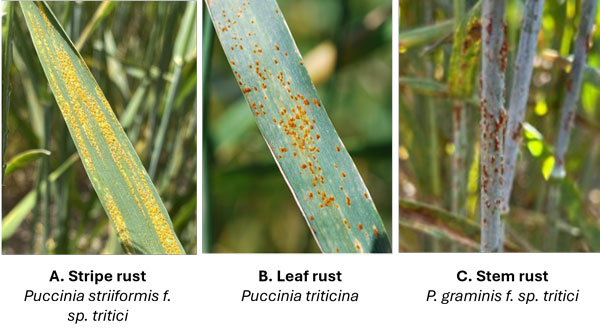
Figure 1. Classic symptoms of stripe (A), leaf (B), and stem (C) rust. If you run your finger over these rusts, the spores will “wipe off” turning your hands (or boots) orange. Photos courtesy of Kesley Andersen Onofre and Erick DeWolf, Kansas State University.
Leaf Rust Risk
Leaf rust (Figure 1b) is a regular threat to the wheat crop in Kansas, though it has arrived late in the season over the last several years, limiting its impact. As a reminder, leaf rust thrives under warm, wet conditions (while stripe rust does better in cooler temps).
This past fall, we observed higher-than-normal levels of leaf rust active in the Kansas wheat crop (https://eupdate.agronomy.ksu.edu/article/fall-infections-of-rusts-in-kansas-wheat-675-1). Luckily, most of that leaf rust was killed off over the winter by cold conditions. There is, however, a small chance that leaf rust survived the winter in some of those locations. Fields that had high levels of leaf rust in the fall of 2025 should be carefully scouted in the spring of 2026.
As a reminder, it’s more common for our wheat rusts to “migrate” to Kansas from southern each spring. As of this week, Brandon Gerrish, Wheat Extension Specialist with Texas A&M, reported that high levels of leaf rust have been reported in irrigated nurseries in Castroville and Uvalde, TX. Producers have reported significant leaf rust in fields near Brady, TX, in the southern Rolling Plains, and small pockets of leaf rust at the trial site near Greenville, TX. Meriem Aoun, Wheat Pathologist and Extension Specialist at Oklahoma State University, reported that low levels of leaf rust were observed in one Oklahoma county in early January, but there have been no reports since (Read the Oklahoma disease update here: https://extension.okstate.edu/e-pest-alerts/2026/wheat-disease-update-march-2026).
Stripe Rust Risk
Currently, the stripe rust risk for the 2026 season in Kansas appears to be low. We have received reports that stripe rust levels have been low overall in Texas this year. As of today’s publication, we have not received any reports of stripe rust in Oklahoma or Kansas. Historically, stripe rust detections in Kansas prior to April 15 have been associated with bad stripe rust years. Scouting efforts over the next few weeks will remain very important for determining the full extent of the risk.
Research from K-State has found that weather conditions in Texas during key periods over the winter are good predictors of how likely it is that stripe rust will be a risk in Kansas in the spring.
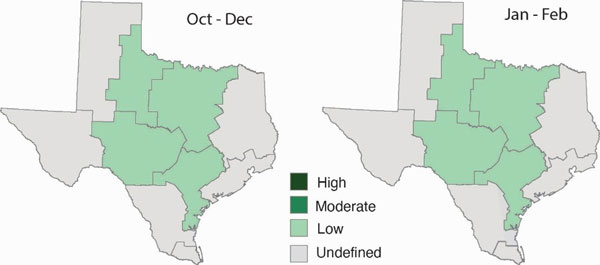
Figure 2. K-State research has shown that the annual severity of stripe rust outbreaks in Kansas can be predicted by soil moisture in key regions of Texas in both the fall and the early spring. In 2025, soil moisture in Texas was low (indicated by light green colors on the map). In the spring of 2026, moisture in key regions of Texas was also low. These maps show soil moisture levels based on the “Palmer Z-Index” provided by NOAA-National Centers for Environmental Information. Maps courtesy Erick DeWolf, Kansas State University.
The maps above indicate that conditions this fall/winter were dry in parts of Texas that are important for stripe rust overwintering. Right now, all models indicate that the stripe rust risk is generally low this year. Historically, years that begin like this have ended with lower-than-average yield losses from this disease in Kansas.
Of course, stripe rust severity in Kansas is still driven by weather conditions in late spring. Once stripe rust is detected in Kansas, cool evenings and extended periods of canopy moisture will be necessary for disease establishment at levels that would result in yield losses.
Stem Rust Risk
Thanks to long-term breeding efforts, stem rust risk has remained low in Kansas over the past decade. It is still important to remember that it can be a problem for susceptible varieties, particularly late in the season, if the weather is conducive. Stem rust can be distinguished from leaf rust based on its ability to fully colonize the stems along with the leaves (Figure 1c). This rust is favored by hot conditions and wet weather. There are a few popular varieties in Kansas that are susceptible to stem rust. As always, scouting should be prioritized in fields with susceptible varieties.
Final Reminders
The disease situation can change rapidly, and it is important to continue to scout for signs of disease development as the season progresses. We will continue to provide updates on rust occurrence and weather outlook as we move toward critical growth stages for fungicide applications in Kansas over the next several weeks.
Again, now is a good time to double-check the resistance of our varieties to wheat rusts at https://bookstore.ksre.ksu.edu/pubs/kansas-wheat-variety-guide-2025_MF991.pdf.
Please contact me (andersenk@ksu.edu, m: 785-410-2426) if you detect stripe rust in Kansas so we can update regional maps.
Kelsey Andersen Onofre, Extension Plant Pathologist
andersenk@ksu.edu
Erick DeWolf, Plant Pathologist
Tags: disease wheat rust wheat stripe rust leaf rust stem rust