Although drought stress remains the dominant concern for the 2026 wheat crop, we are continuing scouting efforts for major wheat diseases in the region. Here we provide a quick update on the status of wheat rusts in the state. In addition, we provide an update about Fusarium head blight (FHB) risk.
This week, leaf rust has appeared in additional counties (Figure 1), particularly in fields that have experienced periods of moisture. Irrigated fields may be particularly vulnerable. Overall, prevalence remains low and observations have been at trace levels. With recent wet weather, we may see leaf rust levels continue to build. Stripe rust was also reported at low levels last week (Figure 2). As a reminder, we reviewed the key differences between leaf, stem, and stripe rust on April 2: https://eupdate.agronomy.ksu.edu/article/wheat-rust-outlook-and-reminders-for-the-2026-season-689-3. Last week, we reported the first detections of leaf and stripe rust in Sumner County: https://eupdate.agronomy.ksu.edu/article/wheat-disease-update-scab-risk-and-rust-outlook-692-5.
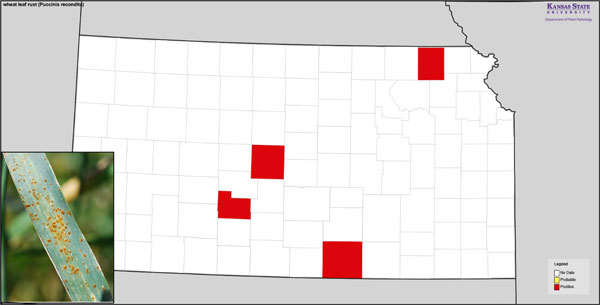
Figure 1. Leaf rust status in Kansas as of April 30, 2026. Most reports have been at low levels to date. Red means at least one confirmed observation within the county. Real-time updates can be found here: https://wheat.agpestmonitor.org/.
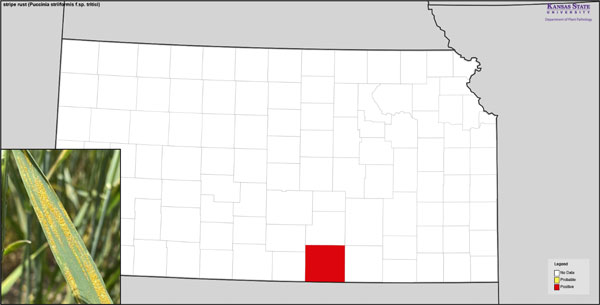
Figure 2. Stripe rust status in Kansas as of April 30, 2026. Most reports have been at low levels to date. Red means at least one confirmed observation within the county. Real-time updates can be found here: https://wheat.agpestmonitor.org/.
Now is a great time to double-check variety ratings for leaf and stripe rust. Many varieties that are common in Kansas have ratings of 4 or better for leaf rust and would likely not benefit from a fungicide application (https://bookstore.ksre.ksu.edu/pubs/kansas-wheat-variety-guide-2025_MF991.pdf). If a variety rates 5 or higher for leaf rust, that field should be scouted more closely (if it is still within a fungicide application window). As a reminder, most fungicides have preharvest intervals that are growth-stage or time-to-harvest based (e.g., 30 days to harvest). There are many fungicides labeled for the control of both leaf and stripe rust. The efficacy of major products is summarized in the 2026 wheat fungicide efficacy guide: https://bookstore.ksre.ksu.edu/download/foliar-fungicide-efficacy-ratings-for-wheat-disease-management-2026_EP130.
In addition to leaf and stripe rust activity, the risk for Fusarium head blight (scab) remains high in the southeast part of the state (extending into south central and northeast counties) (Figure 3). We more extensively reviewed reminders for Fusarium head blight management last week (https://eupdate.agronomy.ksu.edu/article/wheat-disease-update-scab-risk-and-rust-outlook-692-5).
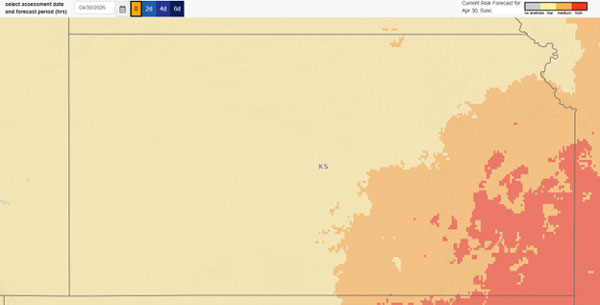
Figure 3. Fusarium head blight (scab) risk for April 30, 2026. Red areas indicate the most favorable weather for scab over the last two weeks, and yellow indicates less favorable weather. This model is calibrated for susceptible varieties of winter wheat. This interactive map can be accessed at www.wheatscab.psu.edu.
As always, you can report wheat diseases to me (andersenk@ksu.edu) or your local K-State County Extension Office.
Kelsey Andersen Onofre, Wheat Pathology Extension Specialist
andersenk@ksu.edu
Tags: wheat disease stripe rust leaf rust