The wheat crop is ahead of schedule across the state and battling drought stress. Because of this, diseases have been slow to develop. In this article, we recap the current Fusarium head blight risk and provide updated reports of wheat rust in the state.
Fusarium head blight (scab risk) is elevated in the southeast
The weather is currently favorable for scab development in southeast Kansas, and risk is elevated moving into central Kansas according to wheatscab.psu.edu (Figure 1). This model considers weather conditions favorable for scab development over a 14-day window. Flowering (Feekes 10.5.1 - https://bookstore.ksre.ksu.edu/pubs/wheat-growth-and-development-poster-20x30_MF3300.pdf) is the critical window for a fungicide application to control Fusarium head blight (scab). It will be important to carefully watch risk in fields that are approaching the critical application window for a fungicide application (flowering- Feekes 10.5.1). The highest risk will be in fields planted with scab-susceptible varieties and planted back into corn residue. Continued wet weather around flowering will increase our risk of scab in Kansas. For a reminder about the scab ratings for individual varieties, please refer to the Kansas Wheat Variety Guide: https://bookstore.ksre.ksu.edu/pubs/mf991.pdf.
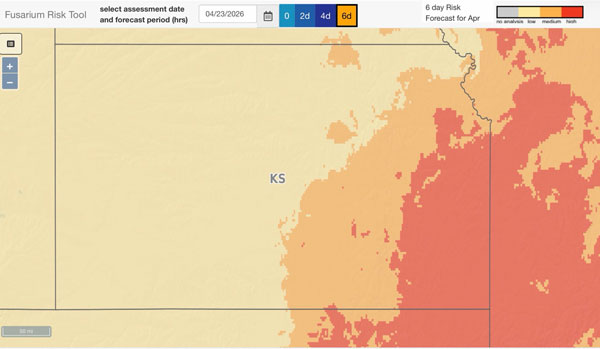
Figure 1. Fusarium head blight (scab) risk for April 23rd, 2026. Red areas are regions with the most favorable weather for scab over the last two weeks, and yellow indicates less favorable weather. This model is calibrated for susceptible varieties of winter wheat. This interactive map can be accessed at www.wheatscab.psu.edu.
As a reminder, scab infection occurs at flowering, but symptoms are not visible for 14-21 days after infection (Figure 2). Because of this, we cannot scout for scab the same way we do for stripe rust or other foliar diseases. Fungicide decisions need to be made based on weather-related risk and the field’s yield potential. Not only can scab lower yield and test weight, but it also produces a mycotoxin (vomitoxin, DON) and can produce grain that is “scabby,” which can sometimes lead to discounts.
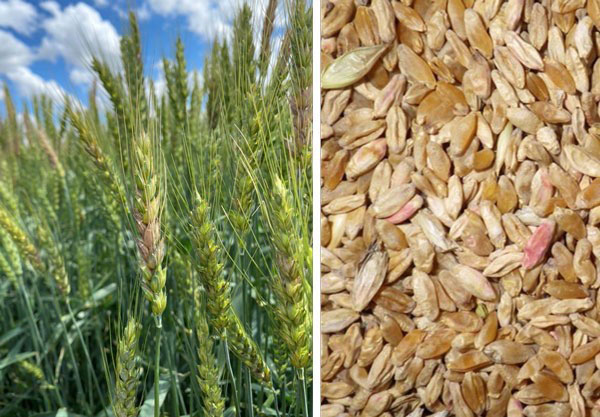
Figure 2. Fusarium head blight (scab) infection often begins with bleaching of infected spikelets and will progress throughout the head. When humidity is high, orange fungal structures are visible on the outside of the spikelet. The grain from infected heads may appear lightweight, white, or pink. Photos by K-State Extension.
Reminders for scab fungicide applications
Fungicide products - Fungicides such as Miravis Ace, Prosaro, Sphearex, Prosaro Pro, and generic equivalents are known to suppress scab (head blight). Specific fungicide performance for scab and other diseases can be found here: https://bookstore.ksre.ksu.edu/pubs/EP130.pdf. Other fungicides are not labeled or not recommended for scab control, particularly products containing strobilurin (FRAC group 11 – azoxystrobin, pyraclostrobin, etc.). As a reminder, all products that control scab will also control stripe rust and other foliar fungal diseases.
Timing – Because the wheat crop is ahead of schedule, we are getting questions about applying after the flowering period. Fungicides are most effective against scab when applied at early flowering (Feekes 10.5.1), and can provide disease protection even when applied later in the flowering window (7-10 days after flowering begins). It is important to pay attention to pre-harvest intervals at this point in the season and to follow the guidelines provided on product labels. The products listed above either have a 30-day pre-harvest interval (cannot be applied within 30 days of harvest) or cannot be applied after Feekes 10.5.4 (end of flowering, watery ripe growth stage).
It is important to remember that flag-leaf fungicide applications will have little to no effect on scab control.
Rainfastness - With the current wet weather, we are getting many questions about fungicide rainfastness. Rainfast time is the period of time between the application of a fungicide and a rainfall event during which the fungicide will not lose efficacy. This information is often not included on the product label or is ambiguous. Rainfast time will vary with temperature and canopy moisture, but most products recommended for wheat in Kansas will be rainfast within 2 hours and likely within 1 hour under most conditions. Rainfastness is improved when a product is applied with a non-ionic surfactant.
Residual life - The residual life of the fungicide application is influenced by the product used, the environment, and the application rate. In general, products in the triazole and strobilurin classes of fungicides will run out of gas (you may start to see symptoms) after 21 days (about 3 weeks). Small differences in residual life among products typically do not result in large differences in grain yield. Some newer products are promoted as having much longer residual lives, but we don’t have university research that supports those claims.
Seed treatments - Seed treatments do not have any influence on disease protection during the growing season, as the fungicides in these seed treatments wear off within 30-45 days of emergence. Seed treatments can improve the emergence of seed from infected fields, as this pathogen can cause seedling diseases when infected seed is planted back.
Stripe rust update and outlook
We received our first observations of low/trace levels of stripe and leaf rust in Kansas this week from Sumner County (Figure 3). We are continuing to scout and monitor the situation and will update the regional map with new observations: https://wheat.agpestmonitor.org/stripe-rust/ (Figure 4).
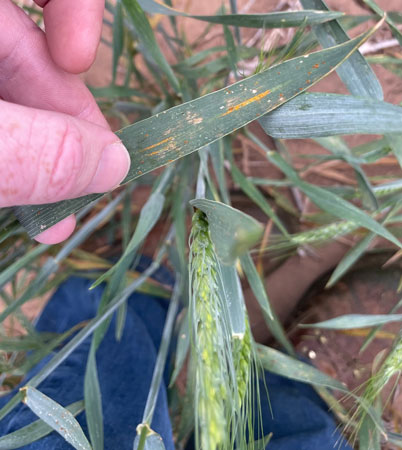
Figure 3. Stripe and leaf rust were observed at low/trace levels in Sumner County, Kansas, on April 22, 2026. Photo: Jeff Seiler, K-State Extension Sedgwick County.
Overall, the risk of widespread loss in Kansas remains low. Three factors are driving this low risk at this point in the season: 1) rust is arriving late in the season compared with previous years; 2) the wheat crop is ahead of schedule in most areas; and 3) conditions have been very dry through most of the state. Because of this, leaf and stripe rust will have a difficult time getting established at high enough levels to cause yield loss.
Scouting efforts should continue over the next few weeks as we move through critical growth stages across the state. Scouting efforts will be particularly critical in the portions of the state where the wheat growth stages are much less advanced. As a reminder, the probability of a positive return on a fungicide application greatly diminishes when disease pressure is absent.
If you detect stripe rust, please contact me at andersenk@ksu.edu so we can verify and update regional maps.
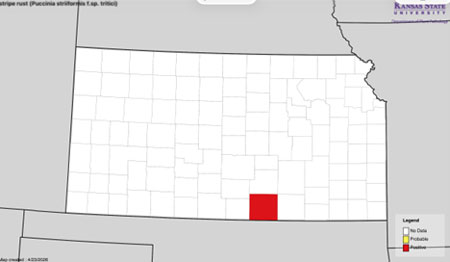
Figure 4. Counties where wheat stripe rust has been confirmed as of April 23, 2026. Real-time updates can be monitored at https://wheat.agpestmonitor.org/stripe-rust/.
Kelsey Andersen Onofre, Extension Wheat Pathologist
andersenk@ksu.edu
Tags: wheat disease leaf rust fusarium head blight head scab