Wheat crop status and N considerations
The wheat crop across the state best be described as variable, with tall wheat with thick stands in some areas and thinner, smaller wheat in other areas. As discussed in last week’s K-State Agronomy eUpdate article (https://bit.ly/4cEi2nn), warmer temperatures and longer days will cause wheat to gradually lose its winter hardiness and progress out of dormancy. In parts of the state, our wheat is moving along and appears to be a bit ahead of what would typically be expected at the end of February.
At this time, it is important to think ahead to the next growth stages of the wheat. That includes the head development and setting the potential number of spikelets per head. Some may know the term spikelet as a ‘mesh’ or the structure where kernels are formed and attached to the rachis (wheat stem). The potential number of spikelets is determined at Feekes 5, when the leaf sheaths are strongly erect. This is before jointing (Feekes 6, when the first node of the stem is visible).
Because of the early green-up in parts of Kansas, now is the time to prepare for topdressing nitrogen. Some key elements to consider when deciding on the program you plan to use include timing, N source, application method, and N rate. Ideally, the N in topdress applications will be moved into the root zone with precipitation well before jointing begins in order to be most efficiently utilized by wheat. With some small wheat with limited tillers, having adequate N available to support spring tillering when it breaks dormancy will be important. Also, the potential number of kernels per head is determined right after spring green-up and prior to jointing; thus, having available N in the root zone can help ensure a good yield potential. Some combination of fall pre-plant, at-seeding N, and/or early topdressed N is also normally needed to supply adequate N to support head differentiation. This article will discuss some issues to consider when making topdressing decisions.
Application Timing
Timing is usually the most important factor in getting a good return on topdress N. Getting the N on early enough is critical to have the maximum potential impact on yield, especially in a year with limited fall tillering. While waiting until spring just prior to jointing can be done successfully, this can be too late in some years, especially when little or no N was applied in the fall. For the well-drained, medium- to fine-textured soils that dominate our wheat acres, the odds of losing much of the N that is topdress-applied in the winter is low. For these soils, topdressing can begin anytime now, and usually, the earlier, the better. For wheat grown on sandier soils, earlier is not necessarily better for N applications. On these soils, there is a greater chance that N applied in the fall or early winter could leach completely out of the root zone if precipitation is unusually heavy. Waiting until closer to spring green-up to make topdress N applications on sandier soils will help manage this risk.
On poorly drained and/or shallow claypan soils, especially in south central or southeast Kansas, N applied in the fall or early winter would have a significant risk of denitrification N loss. Waiting until closer to spring green-up to make topdress N applications on these soils will help minimize the potential for this N loss.
Remember that N should not be applied to the soil surface when the ground is deeply frozen, especially snow-covered. This will help prevent runoff losses with snow melt or heavy precipitation. Additionally, once the soils start to melt, they will likely be too wet for any field work. Therefore, every field should be considered for characteristics such as slope, N source, tillage system, and the short-term forecast for temperature and precipitation.
Split applications may be a strategy to consider on sandy soils subject to leaching and poorly drained soils prone to denitrification. This would involve applying enough N in the fall at or before planting to support fall growth and tillering -- generally 20-30 pounds of N. Then, follow up with an additional application of about 20-30 pounds of N in late winter or early spring to support spring tillering, possibly applied with herbicides. This late-winter/early-spring application becomes especially important when stands are thin due to poor emergence, as many fields are this year. Finally, return around jointing or a few days later with a final application to support heading and grain fill. This strategy can also provide flexibility in a year like this with poor fall growth, allowing us to hold back part of the N for later in the spring as we have a better idea of soil moisture and weather conditions for the season.
Application Method
Most topdressing is broadcast applied. In high-residue situations, this can result in some immobilization of N, especially where liquid UAN is used. If no herbicides are applied with the N, producers can benefit from applying the N in a dribble band on 15 to 18-inch centers. This can minimize immobilization and may provide for a more consistent crop response.
Nitrogen Source
The typical sources of N used for topdressing wheat are UAN solution and dry urea. Numerous trials by K-State over the years have shown that both are equally effective. In no-till situations, there may be some slight advantage to applying dry urea since some of it will fall to the soil surface (Figure 1) and be less affected by immobilization than broadcast liquid UAN, which tends to get hung up on surface residues.
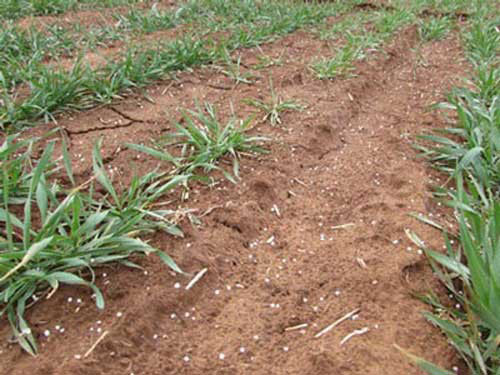
Figure 1. Urea broadcast to tillering wheat in a topdress application. Photo by Romulo Lollato, K-State Extension.
Dribble (surface band) UAN applications would also avoid some of this tie-up on surface crop residues. However, if producers plan to tank-mix with an herbicide, they must use liquid UAN and broadcast it.
Broadcast applications of UAN solution greater than 10 gallons per acre can cause leaf burn on young wheat plants, which may be especially visible in tall, thick stands this year. Risk of leaf burn is especially true if applications are made to actively growing wheat when ambient air temperatures are greater than 60°F. However, this type of injury is almost always cosmetic and rarely reduces yield when applied at optimal growth stages (Feekes 4).
Controlled-release products such as polyurethane-coated urea (ESN) might be considered on sandy soils prone to leaching or poorly drained soils prone to denitrification. Generally, a 50:50 blend of standard urea and coated urea will immediately provide some N to support tillering and head development and continue to release some N in later stages of development. This would work best in settings with high loss potential.
Nitrogen Rate
Producers should have started the season with a certain N recommendation, ideally based on a profile N soil test done before the crop is planted and before any N has been applied. If a soil sample was taken at sowing, profile nitrate-N can help determine the rate to be applied based on the yield goal. However, it is not too late to use the profile N soil test if taken in late winter/very early spring before green-up. While it will not be as accurate as when sampled in the fall, it can still identify fields or areas in fields with high levels of available nitrate N. Unfortunately, it is not reliable in measuring recently applied N. So, if a high rate of N has already been applied, a late winter profile sample probably shouldn’t be taken. Remember that topdressing should complement or supplement the N applied in the fall and the residual soil N present in the soil. The total N application, planting and topdressing, should equal the target recommended rate.
If the wheat was grazed this fall and winter, producers should add an additional 30-40 lbs N/acre for every 100 lbs of beef weight gain removed from the field. If conditions are favorable for heavy fall and/or spring grazing, additional N may be necessary, especially for a grain crop.
Some fields may also benefit from the application of sulfur and chloride. Like N, these nutrients are mobile in the soil, and a topdress application before jointing is considered an effective application time. Sulfur and chloride topdress applications should be made based on soil tests and the history of response.
Dorivar Ruiz Diaz, Nutrient Management Specialist
ruizdiaz@ksu.edu
Logan Simon, Southwest Area Agronomist
lsimon@ksu.edu
Jeanne Falk Jones, Northwest Area Agronomist
jfalkjones@ksu.edu
Tina Sullivan, Northeast Area Agronomist
tsullivan@ksu.edu
Romulo Lollato, Wheat and Forages Specialist
lollato@ksu.edu
Tags: wheat topdress nitrogen fertilizer