This past year (2025) was hard on forage producers once again, with fall armyworms arriving in late July and overstaying their welcome through the long, warm fall. Many across eastern Kansas reported a complete or partial loss of their brome stands (Figure 1). Brome field damage varied greatly, with some fields that appear dead, while others have no damage at all. The majority of the damaged areas were the late-harvested fields cut in mid-to-late July and after. Fall armyworm moths used those recently harvested fields to lay their eggs. Fall armyworm moths can lay their eggs on almost any foliar material, and once hatched, the larvae march for a food source.
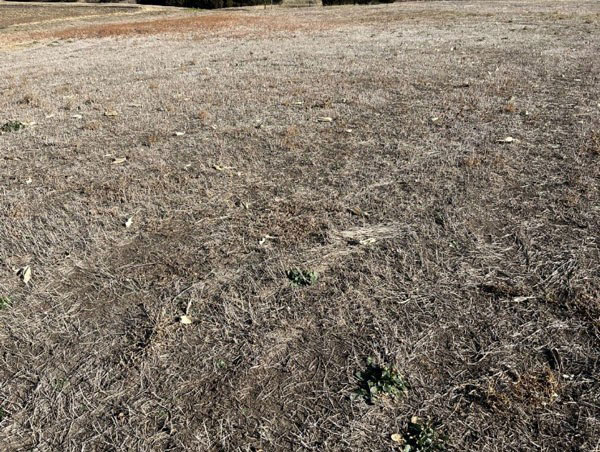
Figure 1. Dead brome field in eastern Kansas. Photo credit: Rod Schaub, K-State Extension.
When brome is cut late in July, it's growing in suboptimal conditions, as it’s a cool-season grass that doesn't like 90°F temperatures. Limited leaf material left after cutting leaves the crown vulnerable (just a few inches tall) to fall armyworm feeding. This feeding, plus limited summer rains, tends to turn the field brown. When we received rain, some fields greened up, but not all of them. With a warmer fall, some fields did not appear to bounce back, and now with the spring temperatures proving to be warmer, many questions are coming up about these damaged fields.
Are the brome plants alive? Is there potential for regrowth?
A drive‑by evaluation can be misleading, especially when grassy annual weeds (such as foxtail) died alongside dormant perennial forage. The only reliable method is to inspect plants directly.
Check for living rhizomes. Dig up a grass clod and examine the rhizomes. Living rhizomes mean new tillers should come up as precipitation comes and temperatures remain warm. Signs of life include roots holding onto soil material or greening up at the root base.
Conduct a bag test. Collect several plant samples, rinse the roots free of soil, and trim shoots to about an inch above the crown. Remove roots, moisten the crowns with cool tap water, and seal the samples in a plastic bag for 2–5 days at room temperature, out of direct sunlight. Living plants will produce new roots and shoots. If no growth occurs within six days, the plant is likely dead.
Management Options
In a “normal” year, with regular supply and input prices (seed, fertilizer, herbicide, etc.), the plan would be to calculate the damaged area, have a well-prepared seedbed, and seed with 10 to 15 pounds of pure live seed (PSL)/acre. If a poor seedbed exists, seeding rates as high as 20 pounds PLS per acre may be required to obtain satisfactory stands. Higher seeding rates should be used when brome is broadcast on the surface and covered. In addition, soil samples should be taken and a fertility program prepared, applying lime, nitrogen, phosphorus, and potassium as needed. More information on Smooth Brome production and utilization can be found at: https://bookstore.ksre.ksu.edu/pubs/c402.pdf
With high costs, springtime planting tends to be less ideal than fall planting, and with concerns about another high-damage year of fall armyworm, other forage options may need to be identified. However, we don’t know if 2026 will have high fall armyworm pressure. It’s always a good idea to prepare and pay attention to when moths start showing up in traps and how fast numbers climb.
- Consider alternative forages. If farmers need to produce forage during spring and summer and are concerned about the cost of brome replanting (seed and fertilizer), they can consider summer annual forages such as pearl millet, sorghum-sudangrass, forage sorghum, and crabgrass. These crops yield 4000 to 8000 lbs of forage/acre. This is also an opportunity to consider seeding spring oats, spring triticale, and cereal rye with production ranging from 1,500 to 4,000 lbs of forage/acre. More details are available at: https://www.agronomy.k-state.edu/documents/extension/mf2871.pdf
- Wait and monitor stand recovery. If immediate brome production isn’t essential, growers can observe stands this spring before making a decision. This allows time to assess plant health, monitor input costs, and evaluate market conditions. However, this approach carries financial risk if forage yields end up lower than expected.
- Replant brome where necessary. For producers who rely on brome hay sales and have fields that are clearly dead or severely damaged, reseeding may be necessary. Determine acreage needing establishment and plan for seed, fertilizer (based on soil tests), herbicide, and insecticide as needed. Spring‑planted brome faces significant weed pressure and generally cannot be harvested until the following spring. Fall‑planted brome can be harvested the next growing season.
Final considerations
A damaged or dead brome situation will be very unique in each hayfield. Thus, what your neighbor is doing or has decided to do does not necessarily apply to you and your hayfield. Analyze your field, check the plants, and decide what would be best for your operation. Each field may require a unique solution.
Tina Sullivan, Northeast Area Agronomist
tsullivan@ksu.edu
Tags: damage bromegrass hayfields fall armyworms smooth brome