This latest World of Weeds feature was inspired by a recent question about controlling horsenettle (Solanum carolinense) in pastures. Horsenettle is a member of the Solanaceae family, which also includes weeds such as cocklebur and groundcherry species, as well as horticultural crops such as tomato and potato. Horsenettle can be especially troublesome in hay fields and pastures due to its spines, which reduce palatability, and its potential toxicity from the alkaloid content of leaves, stems, and berries. Green berries are the most toxic part of the plant, but even dried plants and berries contain the toxins. Because of the toxic nature and limited palatability, horsenettle can become problematic and overrun pastures and hayfields if not controlled.
Ecology
Horsenettle is a warm-season perennial plant native to the southeastern United States. It can be found in fields, pastures, and roadsides throughout the eastern 2/3 of Kansas (Figure 1). It is most common in sandier soils. It prefers full sun but tolerates partial shade.
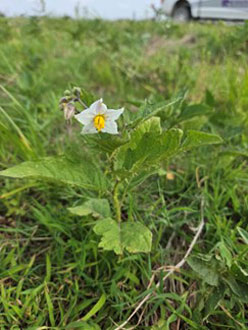
Figure 1. Horsenettle in a bermudagrass pasture. Photo from Wendie Powell, Wildcat Extension District.
Identification
The stems of horsenettle seedlings are covered in short, stiff hairs (Figure 2). They grow to heights of 6 inches to 3 feet, and as the plant ages, they produce prickles. The stem appears to zigzag from branch to branch.
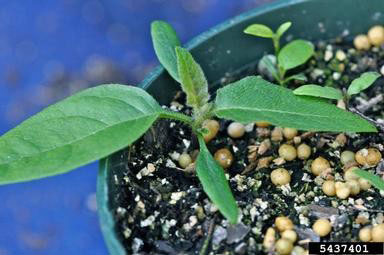
Figure 2. Horsenettle seedlings. Notice the elongated cotyledons and the hairs on the leaves and petioles (stems). Photo by Bruce Ackley, The Ohio State University, Bugwood.org
Horsenettle leaves are attached to the branches in an alternating pattern by prickly petioles (stems). They grow to approximately 2.5 to 5 inches long and 1 to 3.25 inches wide, with wavy or lobed margins. Both leaf surfaces are hairy and have prickles along the veins (Figure 3). The upper surface of horsenettle leaves darker green than the lower surface. Leaves off older horsenettle plants are likely to exhibit insect feeding.
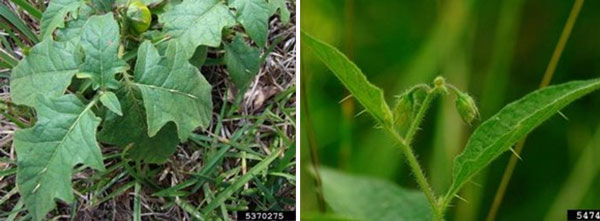
Figure 3. Prickles on the upper (left) and lower (right) surfaces of horsenettle leaves. Note the lobed margins (left) and the alternate arrangement on the stem (right). Photos by Rebekah D. Wallace, University of Georgia, Bugwood.org (left) and Vern Wilkins, Indiana University, Bugwood.org (right).
Horsenettle flowers have five white or purple petals with five yellow anthers in the center (Figure 4). They form in clusters of 5 to 20 at the ends of branches.
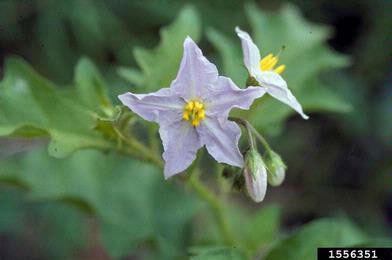
Figure 4. Light purple horsenettle flower with 5 fused petals and 5 yellow stamens. Photo by Ohio State Weed Lab, The Ohio State University, Bugwood.org
Horsenettle berries are round and initially green in color (Figure 5), becoming yellow as they mature. They will remain on the plant and become wrinkled in the fall and winter.
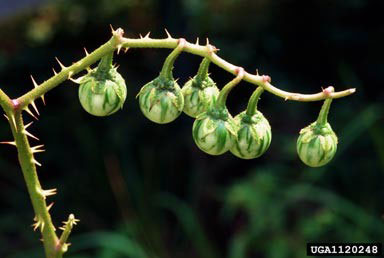
Figure 5. Immature horsenettle berries. Photo by James H. Miller & Ted Bodner, Southern Weed Science Society, Bugwood.org
Horsenettle reproduces from both seeds as well as slender rhizomes and adventitious shoots. Seeds are flat, round, or oval-shaped and glossy yellow, similar to a pepper seed (Figure 6). Up to 170 seeds are produced per berry, with a single plant producing up to 5,000 seeds. Roots can grow up to 10 feet deep and spread up to 20 feet laterally. Some research notes that seed longevity is around 3 to 5 years.
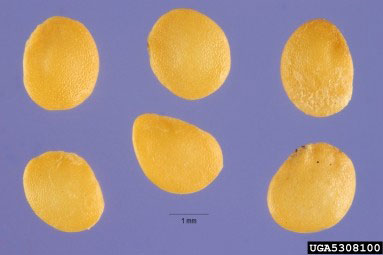
Figure 6. Horsenettle seeds. Photo by Steve Hurst, USDA NRCS PLANTS Database, Bugwood.org
Chemical Management
Horsenettle is not highly competitive, but control is difficult and will require a long-term management plan given its extensive roots and rhizomes. The best time for herbicide application is when horsenettle is flowering, but before berries are set. Fall followed by spring applications may help increase control, but they should be applied while the plant is green and actively growing. Spring or summer applications should be made when horsenettle has begun to flower but has not produced berries.
Effective herbicides for control in pastures include aminopyralid (Milestone), aminopyralid + 2,4-D (Grazon Next), picloram (Tordon, others), picloram + 2,4-D (Grazon P+D), and triclopyr (Remedy, others), or triclopyr + dicamba (Crossbow). When applied alone, 2,4-D, dicamba, or metsulfuron (Escort, others) do not provide satisfactory control.
In glyphosate-tolerant row crops, glyphosate applications are the simplest way to control horsenettle. In corn, mesotrione (Callisto, others) applied postemergence is also effective.
Other Management Options
Nonchemical management options can help prevent horsenettle infestations but are unlikely to control an established population. In pastures, fertility management, grazing management, and haying management are key to establishing a competitive forage stand and preventing the establishment of horsenettle. Mowing can remove the top growth of horsenettle, but, like all weeds, it can adapt to frequent mowing. In cultivated fields, tillage may provide temporary control but will ultimately spread the infestation.
For more information, see the “2026 Chemical Weed Control for Field Crops, Pastures, and Noncropland” guide available online at https://bookstore.ksre.ksu.edu/pubs/SRP1194.pdf or check with your local K-State Research and Extension office for a paper copy.
The use of trade names is for clarity to readers and does not imply endorsement of a particular product, nor does exclusion imply non-approval. Always consult the herbicide label for the most current use requirements.
Sarah Ganske, Weed Management Extension Specialist
slancaster@ksu.edu
Tina Sullivan, Northeast Area Agronomist
tsullivan@ksu.edu