The Kansas Department of Agriculture has announced updates to the Kansas Noxious Weed List. These changes result from collaboration between the Kansas Department of Agriculture Plant Protection and Weed Control Program and the Noxious Weed Advisory Committee. Changes affect all three categories:
- Category A (weeds that are managed for eradication)
- Category B (weeds that are managed to prevent spreading)
- Category C (weeds that are managed to reduce negative effects).
Category A weeds either have limited distribution in Kansas or are not currently found in the state but are considered likely to establish. Category B weeds are known to have discrete populations across the state. Category C weeds have extensive, well-established populations in Kansas. This article summarizes the changes (Table 1) and provides guidance on managing the newly added species.
Table 1. Summary of added and removed species from the Kanas Noxious Weed list.
|
|
Category A (Eradicate) |
Category B (Prevent spread) |
Category C (Mitigate damage) |
|
Added |
Diffuse knapweed |
Common teasel |
Amur honeysuckle |
|
Russian knapweed |
Cutleaf teasel |
|
|
|
Spotted knapweed |
|
|
|
|
Removed |
Pignut (hog potato) |
|
|
In addition to these species, some species are listed as noxious only in certain counties. Caucasian bluestem is listed in Greenwood County, and Bull thistle is listed in Atchison County.
Control options for added weeds
Under Kansas law, landowners and managers are required to control noxious weeds using approved methods. Herbicides to manage these species are available at a reduced price from your county Noxious Weed Department. Herbicides available for cost-share to manage the newly listed plants are listed below.
Diffuse knapweed, Russian knapweed, and spotted knapweed (Figure 1). Herbicides eligible for cost share for all three species are 2,4-D, dicamba, clopyralid (Stinger, others), picloram (Tordon, others), and triclopyr (Remedy, others). Aminopyralid (Milestone) is also listed for diffuse knapweed and spotted knapweed control. Glyphosate, chlorsulfuron (Glean, others), and imazapyr (Arsenal, others) are additional options for Russian knapweed. Applications of these herbicides will be most effective when plants are in the rosette stage, before they produce flowers.
Both spotted and diffuse knapweed are biennial plants, which emerge as low-growing rosettes and generally bolt the following year to reproduce. Because they rely on seed production to reproduce, repeated mowing over several years in the period between the early bud to early flowering stages for these species can effectively stop seed production and eventually eliminate populations. Check that plants are not continuing to bolt below the height of the mower, and keep in mind that rosettes will not be impacted by mowing. For small infestations, plants can also be eliminated by removing them below the root crown. Sheep and goats can also be used to graze these species during the rosette-to-bolting stages and again during the bud stage to reduce populations.
Russian knapweed is a perennial species and much more difficult to control with mechanical methods. Mowing will temporarily suppress Russian knapweed, but must be paired with an herbicide treatment after regrowth to be effective. Russian knapweed can also reestablish from root fragments, so be careful to remove all roots if hand-pulling individual plants, and any approaches that leave root material behind (e.g., tillage) can promote spread. Sheep and goats can be used to graze Russian knapweed, but this species is toxic to horses, and cattle will generally avoid grazing it.
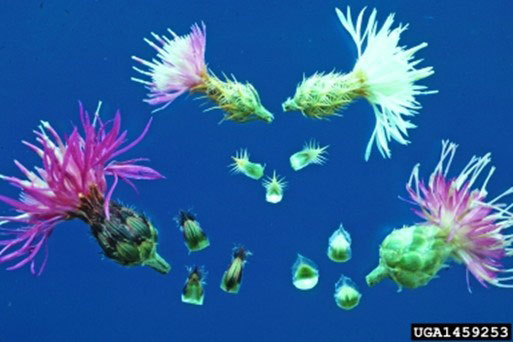
Figure 1. Spotted knapweed (left), diffuse knapweed (center), and Russian knapweed (right). Photo by Steve Dewey, Utah State University, Bugwood.org.
Common teasel and cutleaf teasel (Figure 2). Cost-share eligible herbicides for both species include 2,4-D, glyphosate, aminopyralid (Milestone), imazapic (Plateau, others), and triclopyr (Remedy, others). Metsulfuron (Escort, others) is also available for cutleaf teasel. Applications of these herbicides will be most effective when plants are in the rosette stage, before they produce flowers.
Both common and cutleaf teasel are biennial plants that rely on seed production for their populations to persist. Repeated mowing can be an effective approach to reduce teasel populations. If mowing after flowering, any remaining immature seed heads must be removed and disposed of safely as they can still produce viable seeds. Plants can also be individually removed below the root crown to eliminate small populations. If only aboveground growth is removed, plants may recover and continue to bolt and reproduce.
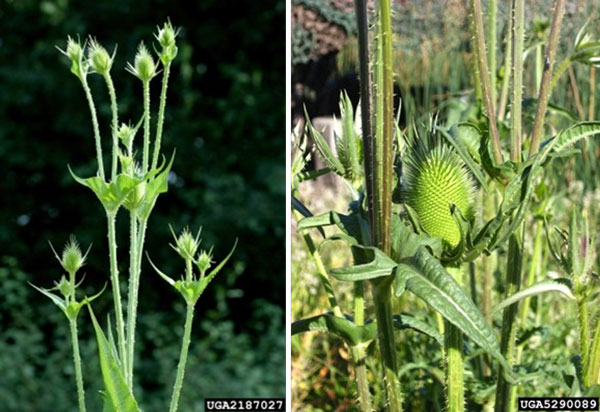
Figure 2. Common teasel (left) and cutleaf teasel (right). Images from David Cappaert, Bugwood.org (left) and Todd Pfeiffer, Klamath County Weed Control, Bugwood.org (right).
Amur honeysuckle (Figure 3). Herbicides eligible for cost share include 2,4-D, glyphosate, imazapyr (Arsenal, others), picloram (Tordon, others), and triclopyr (Remedy, others). Applications can be made in early spring, before desirable species leaf out, or in the fall after desirable species have dropped leaves. Repeated sheep and goat grazing or mechanical removal methods can suppress Amur honeysuckle, but combining mechanical or grazing control with herbicide treatment to address resprouting is recommended (e.g., cut-stump applications). See also the Economical Control of Bush Honeysuckle publication from the Kansas Forest Service for more information on control options for this species.
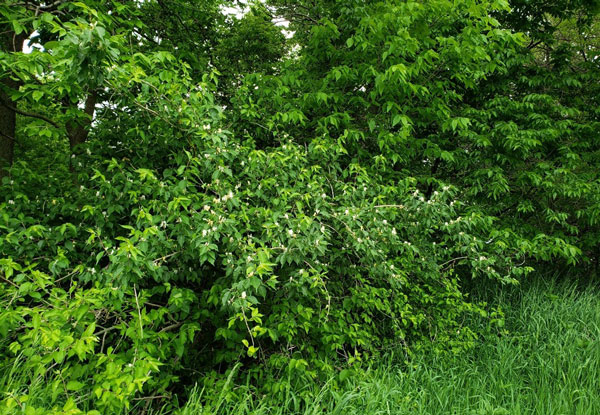
Figure 3. Amur honeysuckle. Photo by Sarah Ganske, K-State Extension.
More information about herbicides for noxious weed management can be found in the “2026 Chemical Weed Control for Field Crops, Pastures, and Noncropland” guide at https://www.bookstore.ksre.ksu.edu/pubs/CHEMWEEDGUIDE.pdf or check with your local K-State Research and Extension office for a paper copy.
Additional information on the Kansas Noxious Weed Control Program, including control methods for these species and all noxious weeds in Kansas, can be found on the Kansas Department of Agriculture website.
The use of trade names is for clarity to readers and does not imply endorsement of a particular product, nor does exclusion imply non-approval. Always consult the herbicide label for the most current use requirements.
Sarah Ganske, Weed Science Extension Specialist
slancaster@ksu.edu
Molly Reichenborn, Range Management Extension Specialist
mreichenborn@ksu.edu