Both barley yellow dwarf (Figure 1) and wheat streak mosaic complex (Figure 2) are showing up across Kansas wheat fields. Although these are both viral diseases, they are transmitted (vectored) by different pests. Here, we review some reminders about these viruses and discuss factors that may have contributed to their occurrence this season.
Barley Yellow Dwarf
Although levels of barley yellow dwarf virus have been lower than normal over the past few years, this virus poses a serious threat to wheat yields. In 2026, we are seeing elevated levels of barley yellow dwarf across the state. As a reminder, barley yellow dwarf virus is transmitted by several species of aphids while they feed, including bird-cherry-oat aphids (Figure 1d), English grain aphids (Figure 1b), and greenbugs (Figure 1c). Bird cherry-oat aphids are particularly well-suited for transmitting barley yellow dwarf virus. This aphid can avoid the hot summer weather that typically eliminates other aphid populations by descending plants to feed at or below ground level. Bird cherry-oat aphid is also able to continue feeding in much colder weather than other aphid species can. The ability to withstand such widely varying temperatures allows the bird cherry-oat aphid to be present in the landscape for a long period of time; even late-planted wheat fields can be at risk of infestation. Compared to other aphid species, the bird cherry-oat aphid tends to be widely dispersed across a field rather than concentrated, making it harder for beneficial insects to effectively eliminate.
Most of the damage from aphid feeding is associated with the transmission of barley yellow dwarf virus to wheat plants. Infection from aphids carrying the virus can occur in the fall or spring, with fall infections having the highest potential for yield loss. Avoiding early planting, using variety resistance, and applying systemic insecticide seed treatments are the best ways to manage early infections.
Symptoms usually appear as purple-to-yellow leaf-tip discoloration, with infected plants appearing stunted (Figure 1a). These symptoms can often be confused with freeze or heat injury. The symptoms of barley yellow dwarf are most visible between jointing and early stages of grain development when warm temperatures favor disease development. Symptoms are typically patchy in a field, with infected plants showing obvious stunting. Heads of infected plants may be darkened before harvest, and grain can be shriveled, resulting in yield losses.
For more information on aphids in Kansas wheat, refer to the Wheat Insect Pest Management Guide at https://bookstore.ksre.ksu.edu/pubs/wheat-insect-pest-management-2026_MF745.pdf
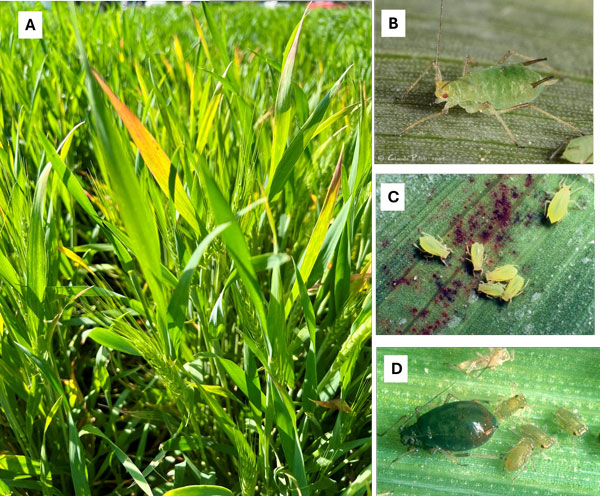
Figure 1. Plants infected with barley yellow dwarf virus typically exhibit red to yellow leaf tip discoloration and will typically be stunted. It is common to see barley yellow dwarf in patches in an affected field. Aphids, including the english grain aphid (A), green bug (B), and bird cherry oat aphid (C) transmit barley yellow dwarf virus. Photos: Kelsey Andersen Onofre and Anthony Zukoff, K-State Extension.
Wheat Streak Mosaic Virus Complex
The viruses that cause wheat streak mosaic need no introduction in many parts of Kansas. Wheat streak mosaic is one of the most economically devastating wheat diseases in the state. Although statewide levels are lower than in 2025, we are again seeing wheat streak mosaic infections in many fields.
Wheat streak mosaic complex is caused by several viruses, including wheat streak mosaic virus, triticum mosaic virus, and High Plains wheat mosaic virus (Figure 2a). These viruses are transmitted by the tiny wheat curl mite (Figure 2b), which survives between seasons on volunteer wheat and other grassy hosts. Infections can occur in the fall or spring but can result in more severe yield loss when they occur in the fall after planting. Wheat streak mosaic symptoms develop most rapidly at temperatures above 70 degrees F. We often see symptoms appear when temperatures warm in the spring. Symptoms appear as green and yellow streaks on wheat leaves (Figure 2a). Infected plants may be stunted with reduced tiller numbers, particularly if infections occurred in the fall.
The best management strategy is to destroy volunteer wheat immediately after harvest and maintain a “wheat-free period” over the summer months. There are some varieties that carry limited resistance to these viruses. More info on how your varieties stack up against this complex of viruses can be found in the Kansas Wheat Variety Guide: https://bookstore.ksre.ksu.edu/pubs/MF3383.pdf
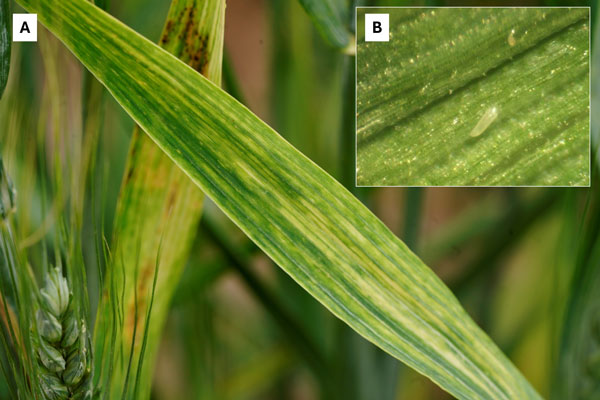
Figure 2. Classic wheat streak mosaic symptoms on a wheat leaf (A) and the wheat curl mite that transmits the virus (B). Wheat curl mites are difficult to see without magnification. Photo: Kelsey Andersen Onofre, K-State Extension.
Sample Submission to K-State Disease Diagnostic Lab
When in doubt, wheat samples can be submitted to the K-State plant disease diagnostic lab (https://www.plantpath.k-state.edu/extension/plant-disease-diagnostic-lab/). As a reminder, a well-submitted sample and fast shipping (FedEx or UPS, not USPS) are key to a good diagnosis. Any questions about sample submission can be directed to clinic@ksu.edu or 785-532-6176. More details about submitting a sample and shipment can be found in this article: https://eupdate.agronomy.ksu.edu/article/k-state-plant-disease-diagnostic-laboratory-fee-adjustments-634-7.
Kelsey Andersen Onofre, Extension Plant Pathologist
andersenk@ksu.edu
Anthony Zukoff, Instructor of Entomology, Garden City
azukoff@ksu.edu