Effective weed control is essential for Kansas grain sorghum producers to achieve strong yields. One of the best management practices for effective weed control is planting grain sorghum into weed-free fields. Grain sorghum planted in a weed-free field, coupled with a strong residual program up front, will start strong and outcompete late-emerging weeds. Once the crop reaches canopy, less sunlight will reach the soil surface, thereby reducing weed emergence. In contrast, grain sorghum planted in fields already infested with weeds will be at a competitive disadvantage for limited resources like soil water, soil nutrients, and sunlight for photosynthesis (Figure 1). Also, the likelihood of chemical weed control failures after crop establishment is higher when grain sorghum is established in a field already infested with weeds.
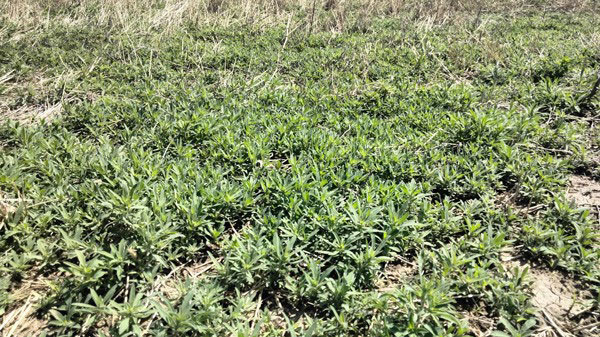
Figure 1. Kochia, an early emerging weed, infesting a field to be planted to grain sorghum, Photo by Jeremie Kouame, K-State Extension
In dryland production systems of western Kansas, conservation tillage is a common practice. This practice helps retain more soil water and increases crop residue on the soil surface, which supports crop intensification. Higher residue amounts also benefit soil health by reducing soil erosion from wind and water, improving soil organic carbon accumulation, and enhancing soil structure. Conservation tillage systems rely on herbicides for effective preplant weed control, thereby making subsequent weed management strategies more effective.
Preplant herbicide options ahead of grain sorghum are limited, and atrazine has been the basis of most chemical weed control programs in Kansas grain sorghum. Some of the options available can be found below.
Atrazine (Aatrex, others) is a group 5 herbicide that can be applied as early preplant, PPI, PRE, and POST. It has some activity on grasses like foxtails, but is considered a broadleaf herbicide. It will control susceptible populations of kochia, pigweeds, morningglories, mustards, and ragweeds. From a weed control standpoint, two major constraints with atrazine are the large number of atrazine-resistant weed populations and the enhanced degradation of atrazine. Both limitations are the result of repeated use of the herbicide. Enhanced degradation occurs when soil microorganisms adapt to atrazine exposure and break the molecule down faster. As a result, the length of residual control may be reduced.
Dicamba is a group 4 herbicide that provides control of susceptible emerged broadleaves and has a moderate residual control of germinating weeds (pigweeds, wild buckwheat, and lambsquarters). Mixtures of dicamba and atrazine in early spring are good options for kochia control. Dicamba (8 fl oz/A) should be applied at least 15 days before planting sorghum.
Glyphosate provides a broad-spectrum control of glyphosate-susceptible weeds present in the field. Glyphosate resistance is widespread in the state, and the herbicide is often mixed with 2,4-D or dicamba for a broader spectrum and increased control.
Mesotrione (Callisto, others) is a group 27 herbicide that may be applied 21 days before planting up preemergence. It is often tank mixed with atrazine or a group 15 herbicide (see below) for increased efficacy and residual control, and is a component of several premixes such as Lumax EZ, Lexar EZ, and Coyote, among others. Mesotrione primarily controls broadleaf weeds such as pigweeds, lambsquarters, kochia, and velvetleaf.
Paraquat (Gramoxone, others) can only be handled and applied by certified applicators and is a nonselective, nonresidual contact herbicide often used for preplant burndown of weeds. Apply in clean water or clear fertilizer solutions to thoroughly cover actively growing annual weeds 1 to 6 inches tall. The rate depends on weed size. Application with atrazine and/or nitrogen carrier may enhance activity. Paraquat formulations will not be available in 2027.
Saflufenacil (Sharpen) is a group 14 herbicide that provides control of many broadleaf weeds like common lambsquarters, marestail, mustards, nightshade, Palmer amaranth, redroot pigweed, wild sunflower, and velvetleaf. Sharpen can be surface-applied preplant or incorporated and has excellent broadleaf burndown activity. It may be tank-mixed with other herbicides, including Clarity, atrazine, and glyphosate. Applying Sharpen to emerged sorghum will result in significant crop injury.
Reviton is a new group 14 contact herbicide developed for nonselective broadleaf and grass weed control or suppression when applied to actively growing weeds. A section 24(c) Special Local Need Label has been released for a reduced plant-back interval to grain sorghum in Kansas. Applied at 1 fl oz/A, grain sorghum should be planted at least 3 days after application, and when applied at 2 fl oz/A, grain sorghum should be planted at least 7 days after application.
Group 15 herbicides. Residual control of weeds that have not emerged can be achieved by including a Group 15 herbicide with a burndown application. S-metolachlor (Dual Magnum, others) can be applied up to 45 days before planting seed treated with Concep III safener. Similarly, if safened seed is used, encapsulated acetochlor (Warrant, others) or dimethenamid-P (Outlook, others) can be applied. Products that contain pyroxasulfone (Zidua, others) are not labeled for use in grain sorghum.
The use of trade names is for clarity to readers and does not imply endorsement of a particular product, nor does exclusion imply non-approval. Always consult the herbicide label for the most current use requirements and follow all label instructions.
For more detailed information, see the “2026 Chemical Weed Control for Field Crops, Pastures, and Noncropland” guide or check with your local K-State Research and Extension office for a paper copy.
Jeremie Kouame, Weed Scientist – Agricultural Research Center, Hays
jkouame@ksu.edu
Sarah Ganske (Lancaster), Weed Management Specialist
slancaster@ksu.edu
Patrick Geier, Weed Scientist – Southwest Research & Extension Center, Garden City
pgeier@ksu.edu