The most critical planting practices affecting sorghum performance are planting date, hybrid maturity, seeding rate, and row spacing. This article on planting dates and hybrid maturity complements a companion article on seeding rate and row spacing.
There is considerable variation in environmental stresses during the growing season for grain sorghum as you move across Kansas from east to west. Tailoring management to local conditions is essential to reduce stress impacts on the crop and maximize yield potential.
Planting date
Grain sorghum can be planted over a wide range of dates (Figure 1). The key is to time planting so flowering avoids the hottest, driest period of summer but still allows time to mature before frost. Utilizing several planting dates is an easy strategy to spread the risk of one single planting date ultimately flowering during a period of heat stress. The initial goal is to establish a uniform stand. Rapid germination and emergence in sorghum occur at a soil temperature of 70°F. Planting too early results in delayed and uneven emergence and reduced stands. Late plantings may not allow the crop to mature before a terminating fall freeze. One potential strategy is to plant fields with low surface residue levels first, as they will likely have warmer soils, and then progress to fields with higher surface residue levels.
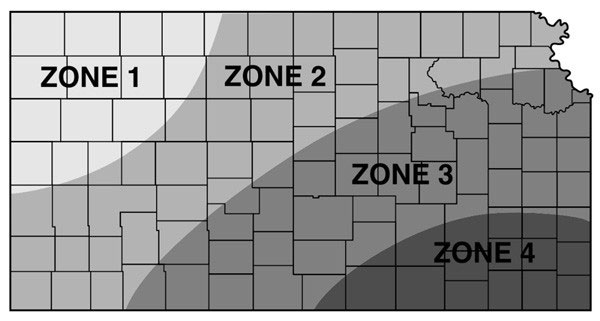
Figure 1. Suggested grain sorghum planting dates: Zone 1 (May 15 to June 10), Zone 2 (May 15 to June 20), Zone 3 (May 15 to June 20), and Zone 4 (May 1 to May 15, June 5 to June 25).
Planting date affects seeding rates. Sorghum will tiller more readily when planted at the optimal date for the location. Later planting generally results in more in-season stress, which reduces tillering, and late-initiated tillers generally are less productive in final grain yield. As a result, later planting scenarios will be on the higher end of the recommended seeding rate range. The potential for greater tillering with earlier planting dates makes sorghum yields more stable when planted in May and early June than in late June or July.
Hybrid selection
The selection of sorghum hybrids should be based on maturity and other traits, such as resistance to pests, stalk strength, head exertion, seeding vigor, and overall performance. For some production issues, such as iron chlorosis, hybrid selection is the most important tool available to producers. Hybrid maturity is related to the probability of reaching physiological maturity (black layer formation) one to two weeks before the first freeze.
Use a shorter-season hybrid when late planting occurs: mid-June in north central or northwest Kansas, late June in south central and southwest Kansas, or July in eastern Kansas. When planted early, long-season hybrids are recommended for making use of the full length of the growing season (greater yield potential).
Producers should consider biotic (chinch bugs and sorghum aphids) and abiotic (excessive heat and drought) stresses when selecting planting dates and hybrid maturity combinations for their operations. Planting early with a medium-maturity hybrid could help avoid heat stress during flowering and sorghum aphid (previously sugarcane aphid) infestation during the boot and early flowering stages. However, chinch bug infestation may be more severe in early-planted sorghum, especially when planted near wheat fields.
Key points
- Time planting so flowering avoids the hottest, driest period of summer but still allows time to mature before frost.
- Establish a uniform stand. Rapid germination and emergence in sorghum occur at 70°F soil temperature.
- The selection of a sorghum hybrid based on its maturity should be related to the planting date, the expected duration of the growing season, and the probability that the hybrid will mature before the first freeze event.
Suggested resources for grain sorghum from K-State Research and Extension
“2024 Kansas Performance Tests with Grain Sorghum Hybrids” SRP1189 https://bookstore.ksre.ksu.edu/pubs/SRP1189.pdf
“Sorghum Growth and Development” poster (updated in 2023)
https://bookstore.ksre.ksu.edu/pubs/MF3234.pdf
Lucas Haag, Agronomist in Charge at Tribune
lhaag@ksu.edu
Logan Simon, Southwest Area Agronomist
lsimon@ksu.edu
Tina Sullivan, Northeast Area Agronomist
tsullivan@ksu.edu