Wheat producers may start seeing some wheat fields turn yellow during this time of the year. The pattern may vary from field to field, sometimes as large areas, small patches, or streaks of yellowish wheat in some fields this spring. What are some of the main weather and disease-related factors that can cause yellow wheat in the spring? A companion article in this eUpdate issue provides more information on poor root growth associated with soil factors.
Poor root growth. Many potential causes exist for reduced root growth: dry soils, later sowing, waterlogging, or elevated crown height caused by shallow planting depth or excessive residue in the root zone (Figure 1). If the plants have a poor root system, their roots are not extensive enough to access sufficient water and nutrients, leading to yellowing.
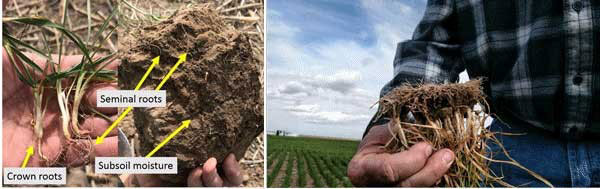
Figure 1. The left panel shows the lack of development of the crown rooting system of a wheat field due to drought conditions in the topsoil. Photo by Romulo Lollato, K-State Extension. The right panel shows a slightly more developed but also extremely shallow rooting system, likely due to a restrictive dry topsoil layer. Photo by Tyler Ediger, wheat producer in Meade County, KS.
Cold weather injury at the tillering stage. A sudden drop in temperature after the wheat has greened up but before it reaches the jointing stage will burn back the top growth, often giving the field a yellowish cast but not necessarily reducing yield potential (Figure 2). This injury is likely cosmetic, provided the growing point is still healthy. Variety release from winter dormancy can also affect the extent of the symptoms, as early varieties would have been less cold-hardy and thus likely sustain more injury.
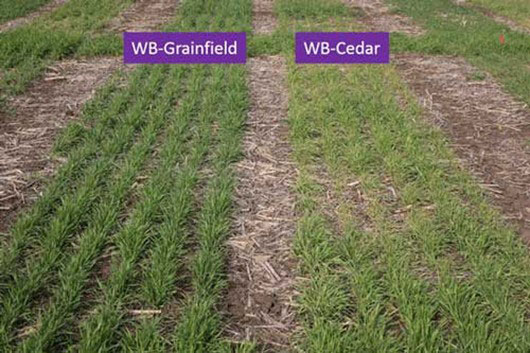
Figure 2. Yellowing wheat from cold weather injury at the tillering stage. The wheat variety on the left (WB-Grainfield) has a later release from winter dormancy than WB-Cedar (on the right). Thus, WB-Cedar sustained more leaf injury. Photo by Romulo Lollato, K-State Extension.
Freeze injury at the jointing stage. Jointing wheat usually tolerates temperatures in the mid- to upper 20s without significant injury. But, if temperatures fall into the low 20’s or below for several hours, the lower stems, leaves, or developing heads can sustain injury (Figure 3). This could be the case this year due to the advanced crop development and the cold temperatures experienced in mid-March 2026. Producers are advised to scout their fields to assess yield potential 10-14 days after the freeze. If the leaves of tillers are yellowish when they emerge from the whorl, this indicates that those tillers have been damaged. More information on assessing wheat for signs of injury can be found in this recent eUpdate article: https://eupdate.agronomy.ksu.edu/article/wheat-status-injury-symptoms-from-freeze-damage-687-4.
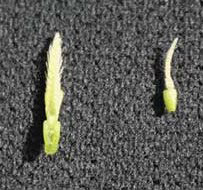
Figure 3. Comparison between a healthy developing wheat head (left-hand side, typically light green and firm) versus a developing wheat head that sustained freeze injury (right-hand side, whitish/brown and mushy). Photo by Romulo Lollato, K-State Extension.
While the extent of potential freeze damage depends on minimum temperatures achieved, duration of cold temperatures, and stage of wheat development, other factors such as crop residue, position on the landscape, wind speed, snow cover, and soil temperatures also play a role. Figure 4 shows an example of the effect of heavy residue on potential wheat damage. In this photo, parts of the field with a heavier layer of residue show greater cold damage than lighter residue. This can be partially explained because, under a thicker layer of residue, the wheat crown tends to form closer to the surface and, therefore, is more exposed to freezing temperatures.
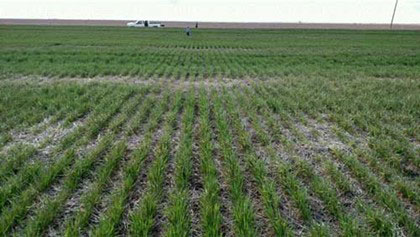
Figure 4. Effect of soil residue on wheat freeze damage. Wheat shows more damage from freezing temperatures in thicker residue layers. Photo by Tyler Ediger, a wheat producer in Meade County, KS.
Leaf senescence and opportunistic leaf spotting diseases. After the winter, it is normal for some of the leaves in the lower canopy to go through senescence and perish, sometimes translocating nutrients to the new growth, and sometimes just due to different natural reasons. This causes the lower wheat canopy to yellow. Some opportunistic saprophytic fungi or fungal diseases, such as leaf spots (Septoria tritici blotch, Stagonospora nodorum leaf blotch, and tan spot), may colonize these dying tissues, as shown in Figure 5. For the most part, in Kansas, these diseases do not cause economic damage as long as they remain on the lower leaves, especially if they occur in tissue already dying. They might become a problem and warrant a fungicide application in specific situations, such as when a susceptible variety is planted into heavy wheat residue – especially under no-tillage practices, and when symptoms appear in the upper canopy after the flag leaf has emerged (see Stagonospora nodorum leaf blotch, in Figure 6).
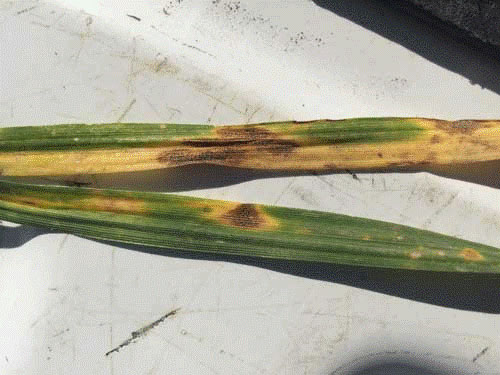
Figure 5. Septoria tritici blotch (leaf spot) colonizing tissue from the lower wheat canopy that was already senescing. Photo by Romulo Lollato, K-State Extension.
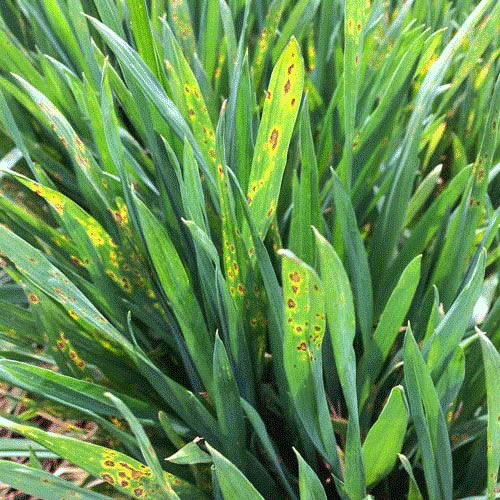
Figure 6. Stagonospora nodorum leaf blotch symptoms in the upper wheat canopy. Photo by Romulo Lollato, K-State Extension.
Soilborne mosaic or spindle streak mosaic. Soilborne mosaic and spindle streak mosaic (Figure 7) are viral diseases that occur primarily in eastern and central Kansas but are rare in western Kansas. These diseases are most common in years with a wet fall followed by a cool, wet spring. These diseases are often most severe in low areas of the field where soil conditions favor infection. Symptoms are usually most pronounced in early spring, then fade as temperatures warm. Leaves will have a mosaic of green spots on a yellowish background. Infected plants are often stunted in growth. Many varieties in the eastern part of the state have high levels of resistance to these viral diseases.
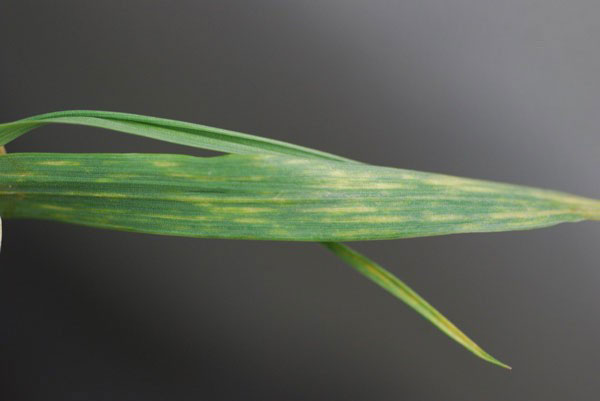
Figure 7. Wheat with symptoms of wheat spindle streak mosaic. Notice the yellow, linear lesions that are tapered at both ends. Photo by Erick DeWolf, K-State.
Wheat streak mosaic complex.
The viruses that cause wheat streak mosaic complex (Figure 8) need no introduction in many parts of Kansas. Wheat streak mosaic is one of the most economically devastating wheat diseases in the state. While this disease is most common in western Kansas, we have seen an uptick in its frequency in central and eastern Kansas over the last couple of years.
This disease complex can be caused by several viruses, including wheat streak mosaic virus, triticum mosaic virus, and wheat mosaic virus (high plains). These viruses are moved around by the tiny wheat curl mite, which survives between seasons on volunteer wheat and other grassy hosts. Infections can occur in the fall or spring, but can result in more severe yield loss when they occur in the fall after planting. Wheat streak mosaic symptoms develop most rapidly at temperatures above 70˚F. We often see symptoms appear when temperatures warm in the spring. Symptoms appear as green and yellow streaks on wheat leaves. Some varieties have limited resistance to these viruses. More info on how your varieties stack up against this complex of viruses can be found in the Kansas Wheat Variety Guide: https://bookstore.ksre.ksu.edu/pubs/MF3383.pdf.
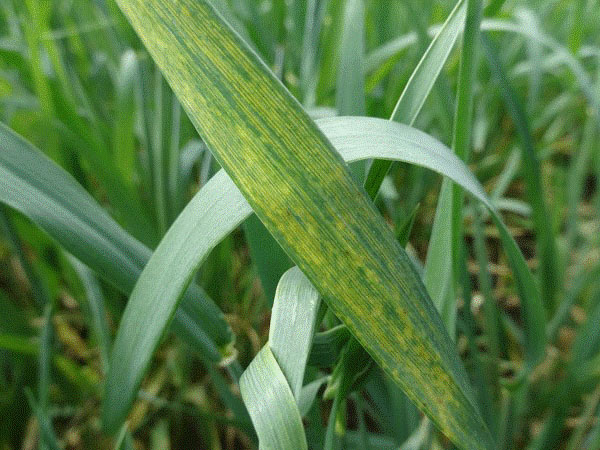
Figure 8. Typical symptoms of wheat streak mosaic virus. Photo by Kelsey Andersen Onofre, K-State Extension.
Barley yellow dwarf. This viral disease is vectored by bird cherry oat aphids and greenbugs. Small or large patches of yellow plants will occur, typically around the boot stage (Figure 9). The leaf tip turns yellow or purple, but the midrib remains green. The yellowing caused by barley yellow dwarf is less botchy than the yellowing caused by other viral diseases. Plants infected by barley yellow dwarf are often stunted.
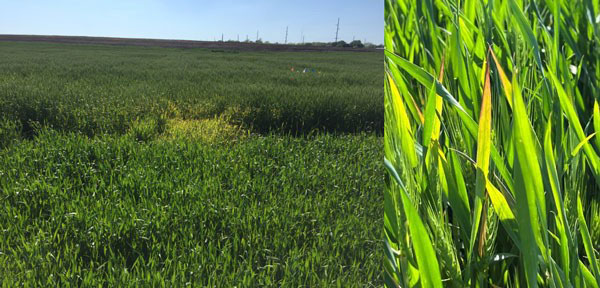
Figure 9. A typical patch of plants showing symptoms of barley yellow dwarf virus infection. (Photo by Romulo Lollato, K-State Extension) as well as up-close symptoms of barley yellow dwarf (Photo by Kelsey Andersen Onofre, K-State Extension)
When in doubt, wheat samples can be submitted to the K-State plant disease diagnostic lab (https://www.plantpath.k-state.edu/extension/plant-disease-diagnostic-lab/). As a reminder, good sample submission and fast shipping (not USPS) are keys to a good diagnosis. Any questions about sample submission can be directed to clinic@ksu.edu or 785-532-6176. More details about sample shipment can be found in this article: https://eupdate.agronomy.ksu.edu/article/k-state-plant-disease-diagnostic-laboratory-fee-adjustments-634-7.
Romulo Lollato, Wheat and Forages Specialist
lollato@ksu.edu
Kelsey Andersen Onofre, Extension Wheat Pathologist
andersenk@ksu.edu
Tags: weather disease yellow wheat