This article presents tips for selecting the best planting date and maturity group for each crop region in Kansas to maximize yield. Planting date is one of the primary management practices under farmers’ control that can strongly influence soybean yields, independent of variety differences and environment.
There has been a trend of planting soybeans early, before corn in some cases, at a rate of about one-third of a day per year. In 2025, the “50% planting date” mark was achieved around May 26 statewide (ahead of the 42% historical average) – with planting progress moving closer to mid-May if conditions are optimal at that time (USDA-Crop Progress Reports). A note of caution: lower soil temperatures will delay emergence and could compromise stand uniformity. In addition, dry conditions can further delay overall emergence, impacting early-season uniformity.
If planting early, try to maximize plant survival and reduce threats to emergence by:
- Avoiding planting when soil temperatures are below 60°F (Figure 1). If planted into soils cooler than 60°F, seedlings may eventually emerge but will have poor vigor.
- Treating seeds with fungicide and insecticide.
- Selecting varieties with resistance to soybean cyst nematode and Sudden Death Syndrome.
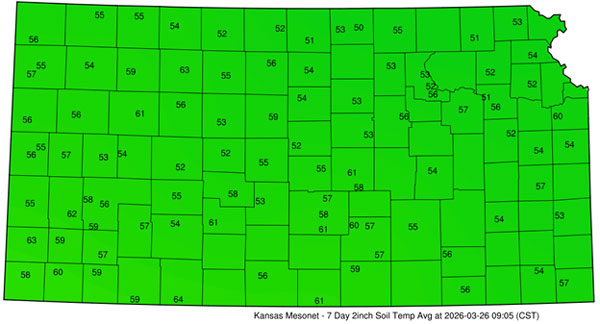
Figure 1. Average 7-day soil temperature at the 2-inch depth for the week of March 20-March 26, 2026. Map from Kansas Mesonet.
Planting dates and maturity group guidelines
Soybeans can be planted over a wide range of dates with adequate soil moisture conditions, although germination and emergence could be reduced and/or delayed in cool soils (less than 60°F). In the last few years, many farmers have anticipated soybean planting dates earlier relative to the ones presented in Figure 2, in many situations, planting soybeans before corn. The recommended maturity group varies across Kansas by area (Figure 3).
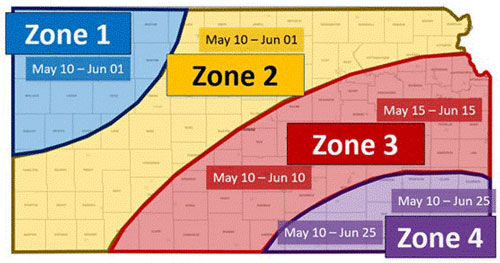
Figure 2. Recommended soybean planting dates under dryland conditions. K-State Research and Extension.
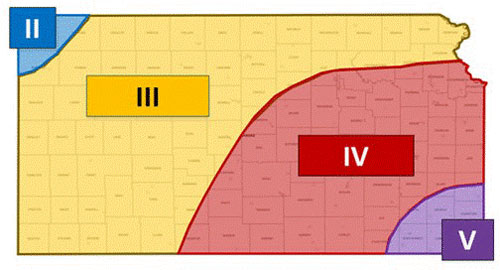
Figure 3. Recommended soybean maturity groups (II to V) across Kansas. K-State Research and Extension.
Over four years at the Kansas River Valley Experiment Field at Topeka, soybean yields were either stable or increased when planting in late March/early April compared to planting in mid-to-late April and early-to-mid May (Figure 4). Similar observations were made at the North Central Experiment Field at Scandia.
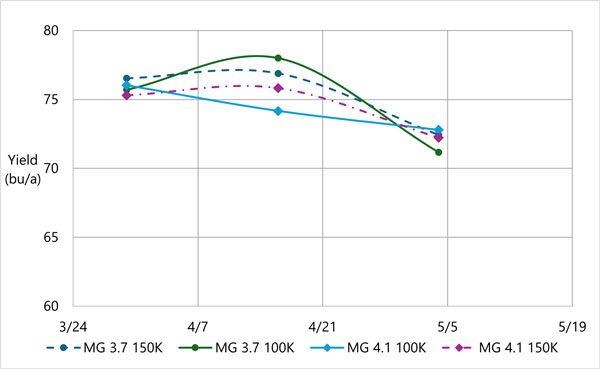
Figure 4: The effect of planting date on irrigated soybean yield at the Kansas River Valley Experiment Field in 2021-2024. Each line represents a maturity group (MG 3.7 or MG 4.1) and seeding rate (100K or 150K).
Generalized for Kansas, the maximum soybean yield is reduced by 0.3 bu/a per day as planting dates move later, with higher yield when planting in mid-April compared to moderate yields (50 bu/a) when planting in mid-July. These results highlight the importance of early planting for obtaining maximum yields and the yield penalty associated with later planting dates. Earlier planting means more risk and yield variability, but a potentially higher yield or reward. Later-planted beans tend to be less variable with more yield stability, though maximum yield potential may be lost.
Final considerations
- In general, do not plant in soils that are too wet, and until soil temperatures are close to 60°F. If planted into soils cooler than 60°F, seedlings may eventually emerge but will have poor vigor.
- The distribution and amount of rainfall and the day/night temperature variations around flowering and during the grain-filling periods also greatly impact soybean yields.
- In drier areas and shallow soil, yields have been most consistent when soybeans are planted in late May to early June.
Tina Sullivan, Northeast Area Agronomist
tsullivan@ksu.edu
Logan Simon, Southwest Area Agronomist
lsimon@ksu.edu
Eric Adee, Agronomist
eadee@ksu.edu
Tags: planting soybeans planting date maturity group optimum planting dates