We can debate whether or not volunteer corn is truly a “weed,” but it can certainly be a problem in soybean fields following corn (Figure 1). According to research conducted in South Dakota, soybean yield loss was 8-9% when volunteer corn density was about 1 plant per 10 square feet. Yield loss increased to 71% at volunteer corn densities of about one plant per square foot. Conversely, other scientists concluded that corn grain yield is not reduced by volunteer corn, so long as the volunteer corn is harvested along with the hybrid corn. However, the authors also noted negative impacts, including inefficiencies in harvest, disease outbreaks, and poor stewardship of insect-resistant traits.
One factor that makes volunteer corn management difficult is the prevalence of glyphosate- and/or glufosinate-resistant varieties and hybrids. In addition, tank mixes with dicamba or 2,4-D to control broadleaf weeds may reduce the effectiveness of glyphosate and Group 1 herbicides like clethodim (Select Max, others) or quizalofop (Assure II, others). However, farmers can take some steps early in the growing season to manage volunteer corn.
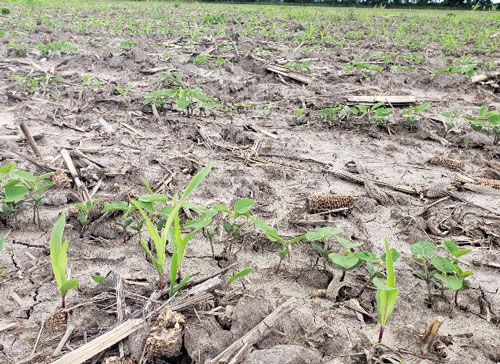
Figure 1. Volunteer corn emerging with soybeans. Photo by Sarah Ganske, K-State Extension.
Burndown options
As mentioned above, glyphosate will not control glyphosate-resistant volunteer corn. Glufosinate (Liberty, others) will control volunteer corn, provided the corn is not glufosinate-resistant (LibertyLink). Paraquat (Gramoxone, others) will also control volunteer corn that has emerged prior to soybean planting. Regrowth is possible if the growing point is not killed, meaning contact herbicides will be ineffective if applied to volunteer corn smaller than V6. Please note that Gramoxone will not be available for sale after 2026 (see the eUpdate article in this issue). Clethodim (Select, others) could also be used in a burndown application, but it should be applied at least six days before corn planting. In some cases, tillage may be the most effective option.
At planting options - soybeans
In research conducted at the University of Nebraska, pre-emergence applications of sulfentrazone in combination with imazethapyr, cloransulam, metribuzin, or chlorimuron (Authority Assist, Authority First, Authority MTZ, or Authority XL) reduced volunteer corn growth compared to non-treated controls. Other treatments, including flumioxazin (Valor, others) alone or in combination with chlorimuron (Valor XLT) or cloransulam (FirstRate), or fomesafen + metolachlor (Prefix) or saflufenacil + imazethapyr (Optill), did not reduce volunteer corn growth. There are no residual herbicide options to control volunteer corn at the time of field corn planting.
Over-the-top options
Group 1 herbicides (Select Max, Assure II, Fusilade, Poast, and others) are typically very effective over-the-top options for volunteer corn control in soybean. However, research from Indiana and Canada suggests that volunteer corn control by clethodim formulations without “fully loaded” surfactants can be reduced up to about 60% when applied with glyphosate or glyphosate plus 2,4-D and up to about 75% when applied with glyphosate plus dicamba. The reduction in control can be minimized by increasing the rate of the Group 1 herbicide to the maximum labeled rate or by using a more aggressive adjuvant. Research from North Dakota suggests that adding a high surfactant oil concentrate (HSOC) can improve volunteer corn control by tank mixtures of clethodim plus glyphosate, but neither NIS nor AMS improves control.
One potential option to control volunteer corn in emerged corn is to use an Enlist® corn hybrid. Enlist corn hybrids can be sprayed with Assure II herbicide, which would control glyphosate and/or glufosinate-resistant volunteers.
For more detailed information, the “2026 Chemical Weed Control for Field Crops, Pastures, and Noncropland” guide is available online at
https://www.bookstore.ksre.ksu.edu/pubs/CHEMWEEDGUIDE.pdf or check with your local K-State Extension office for a paper copy.
The use of trade names is for clarity to readers and does not imply endorsement of a particular product, nor does exclusion imply non-approval. Always consult the herbicide label for the most current use requirements. Users should read and follow all label directions.
Sarah Ganske (Lancaster), Weed Management Specialist
slancaster@ksu.edu