Several reports have been received of alfalfa stands, ranging from new seedings to established fields, not performing as expected. In many cases, symptoms are not uniform within the same field, with patches of healthy plants occurring alongside areas of poor growth (Figures 1 and 2). This article highlights common visual symptoms, what they may indicate, and potential management strategies.
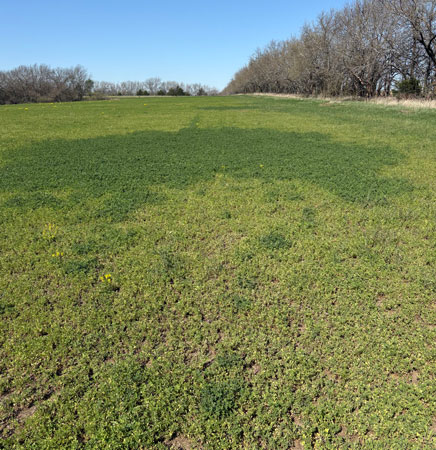
Figure 1. Alfalfa field showing yellowing areas with patches of green, healthy plants. Photo by Rod Schaub, Frontier Extension District.
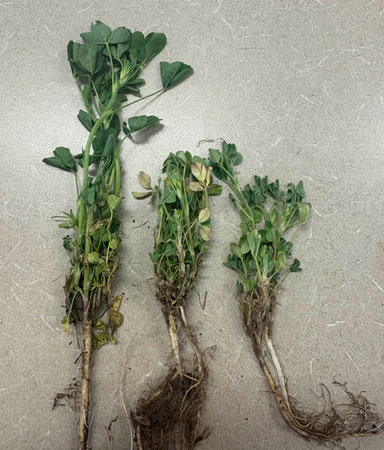
Figure 2. Healthy alfalfa plant (on the far left) with stunted plants from the same field. Photo by Rod Schaub, Frontier Extension District.
Planting depth and seedbed
Alfalfa seed is very small, with a narrow planting depth margin of error. Alfalfa seed should end up about ¼ to ½ inch below the soil surface, with the highest success when drilled. If the seed were placed on the surface of a firm, mellow seedbed and pressed with a roller or press wheel, this should have positioned the seed correctly within the soil. But if the seed is more than ¾-inch deep, it probably won't emerge well. Seeds that remain on the soil surface may germinate, but the seedlings will be weak, especially in broadcast situations.
Dry soils
Seed can be planted into moisture and emerge even if there is no rain after planting. However, alfalfa seed is planted in the very top half-inch of soil, which is almost always dry at the time of planting and lacks sufficient moisture to germinate. As a result, in most situations, alfalfa seed requires rain after planting to germinate and emerge. For best stand establishment, soils should have adequate moisture at about 1 to 3 inches below the soil surface so that seedlings can survive even if the seed germinates from only a very light rainfall.
Poor quality seed
Poor emergence can be caused by using seed with low germination, though this is almost never a problem with certified seed and germination testing. Therefore, it is important to use certified seed with a high germination rate and purity to improve the chances of successful establishment.
Seedling diseases
Several fungi (and oomycetes), including Phytophthora, Pythium, Fusarium, and Rhizoctonia, can attack alfalfa seedlings in Kansas. Traditionally, Phytophthora and Pythium have been considered the primary pathogens in the state. Seedling diseases may be the cause when emergence is poor and/or there are obviously stunted, discolored, or dead seedlings in a newly established stand. Alfalfa seedling diseases are more severe when soils are cool and wet for extended periods. Planting high-quality seed when conditions are favorable for rapid germination and growth is important in reducing losses to seedling pathogens.
Using varieties that are resistant to Phytophthora is your best bet for avoiding this disease. However, the resistance genes may not be expressed when the plants are very small, and it is a good idea to protect the seed treatment with a fungicide seed treatment labeled for Pythium and Phytophthora.
Poor seed inoculation and subsequent nitrogen deficiency
Unless the seed is pre-treated with an inoculant, alfalfa must be treated with a rhizobium inoculant that is specific to alfalfa. If the seed was inoculated but the seedlings are still chlorotic, it may be because the inoculant died during storage. Heat, direct sunlight, and drying can all affect rhizobia's survival. Inoculants should be frozen or stored in a cool place. Prolonged storage can also reduce the viability of rhizobium.
About 10-20 lbs per acre of soil nitrogen is needed for seedlings to develop leaves and roots while the rhizobium is becoming established in the roots. Usually, there is sufficient soil nitrogen available in the type of good soils into which alfalfa is typically planted. But on poorer soils, or in no-till systems, the early-season chlorosis may be caused by nitrogen deficiency. If the seed was properly inoculated and the soil pH is not low, the plants should grow out of this before winter.
Low soil pH
If seedlings are weak, poorly nodulated, or appear nitrogen-deficient, check the soil pH for acidic conditions. Low soil pH hinders the development of a healthy root system, which is crucial for drought tolerance, winter survival, and carbohydrate storage in alfalfa. Acidic conditions also suppress root nodulation and nitrogen-fixation by the bacteria (rhizobia) in the nodules. Alfalfa is very sensitive to acidic soils; thus, lime should be applied if the soil pH is less than 6.5. Low soil pH should be corrected before planting a new stand because lime moves slowly through the soil and reacts more slowly than most fertilizers.
Herbicide carryover
Sulfonylurea herbicide carryover can result in severe stunting of new alfalfa seedlings.
Allelopathy
If alfalfa is seeded into an old alfalfa stand, the new seed will emerge, but the seedlings often have poor early vigor and eventually die. That’s why it is important not to plant alfalfa immediately after alfalfa. After terminating an old stand, it is recommended to wait one year, planting annual forages or grain crops during that time, to minimize allelopathy issues in alfalfa.
Sulfur and boron deficiency
Sulfur is essential for protein synthesis in plants, and with legumes, it is necessary for nodule development. Sulfur deficiency symptoms in alfalfa include a light green coloration of the whole plant, stunting, limited shoot development, and reduced nodulation. This deficiency is more common in fields with sandy soils, low organic matter, when springtime conditions are cool and wet.
Boron is a micronutrient that alfalfa needs for production. Boron deficiency symptoms include small, yellowish to reddish leaves bunched in the top trifoliates, purplish to reddish leaf discoloration increases from the leaf edges and tip, and yellowish symptoms at the plant top are known as “yellow top.” Additional symptoms include delayed maturity, stunting, growing point death, bud discoloration, and lack of flowering or seed production.
Plant tissue tests can be useful for confirming suspected boron or sulfur deficiencies. The whole plant (above ground) should be collected once 6 inches of new growth has occurred.
Insects
Alfalfa weevil damage has already begun in Kansas. Due to the mild winter, increased vigilance is warranted. Regular and timely scouting of alfalfa fields is essential to minimize potential losses in both forage yield and quality.
Aphid activity was reported in several areas earlier than normal. The aphids reported were mainly pea aphids, which can cause yellowing and stunting of plants but are usually kept below threshold by beneficial insects. Later in the season, spotted alfalfa aphids can cause yellow patches due to a toxin they transmit to the plants. Even low numbers of this insect (1 or 2 per seedling) can cause significant damage to alfalfa seedlings and should be controlled. The blue alfalfa aphid, active mainly earlier in the season, can be just as damaging to new alfalfa seedlings, but this insect does not cause yellowing.
Looking ahead to fall, foliar-feeding insects should be monitored. These include grasshoppers, cutworms, yellow-striped armyworm, corn earworm, fall armyworm, and alfalfa webworm. These insects can quickly destroy all plant tissue above the soil surface. Cutworms are an especially serious threat under dry fall conditions. The army cutworm feeds at or below the soil surface, cutting or defoliating plants. Infestations of 2-3 worms per square foot and 3-7 grasshoppers per square yard can be used as a general threshold in seedling alfalfa.
Take-Home Message
- Poor alfalfa performance has been reported in Kansas, with patches of healthy and stressed plants.
- Multiple factors may be involved, including planting conditions for new stands, soil moisture, fertility, pests, and diseases.
- Accurate diagnosis through field scouting is critical before making management decisions.
- Addressing underlying issues early can help improve stand productivity and longevity.
Tina Sullivan, Northeast Area Agronomist
tsullivan@ksu.edu
Romulo Lollato, Wheat and Forages Specialist
rlollato@ksu.edu
Doohong Min, Forage Management
dmin@ksu.edu
John Holman, Cropping Systems Agronomist – Garden City
jholman@ksu.edu
Kelsey Andersen Onofre, Plant Pathology Extension Specialist
andersenk@ksu.edu
Jeff Whitworth, Extension Entomology Specialist
jwhitwor@ksu.edu
Tags: alfalfa disease stunted plants