Though the hemp hype for CBD has died back, there is still interest in hemp production for seed and fiber. The grower rush following the 2018 Farm Bill legalization focused mainly on the high-risk, high-reward portion of CBD hemp production that fell apart as quickly as it became popular. Although less profitable, grain and fiber hemp offer a better market option, though many questions remain. Grain, fiber, and dual-purpose acres have remained steady across the United States, with Kentucky leading, though Kansas production should not be overlooked. From 2022 to 2024, Kansas open acres increased from 980 to 2,150 planted and harvested, up from 530 to 900 acres.
What is Industrial Hemp?
Both industrial hemp and marijuana are part of the Cannabaceae or Cannabis family. Despite the name, hemp is not in the same family as sunn hemp, water hemp, hemp sesbania, or hemp dogbane. The Cannabis family contains 170 species, but only two are agronomically important: Cannabis and Humulus (hops). Cannabis has one species (Cannabis sativa L.) that falls into three subspecies (sativa, indica, and ruderalis) with hundreds of strains. The strains are the cultivars for this crop. Cannabis encompasses all classifications falling into five categories or types:
- Type I: THC-dominant
- Type II: Balanced THC and CBD
- Type III: CBD-dominant
- Type IV: CBG-dominant
- Type V: Very low or no cannabinoids
Medicinal, floral, and oil hemp fall into Types I–IV (the cannabinoid types), while seed and fiber hemp fall into Type V.
Fiber vs Seed vs Oil
The breakdown of the differences between hemp and marijuana, and the connection and potential income associated with each type, is shown in Figure 1. Industrial hemp is often seen as an agronomic crop grown outdoors, while marijuana is more horticultural in indoor, controlled spaces. Overlap comes in the oil/floral/cannabinoid-based hemp types that can be grown indoors or outdoors, but the location choice can greatly affect profitability.
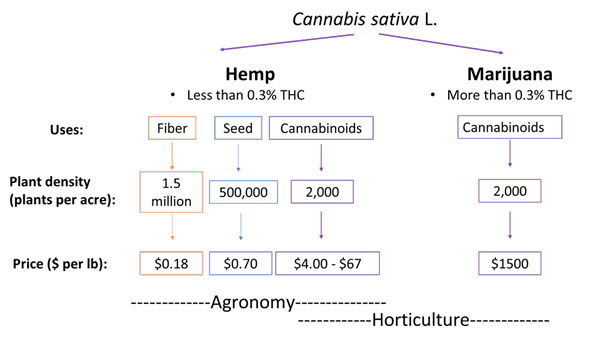
Figure 1. Comparison of hemp and marijuana classifications within Cannabis sativa L., highlighting differences in THC content, primary uses, plant density, and crop value. Figure by Tina Sullivan, K-State Extension.
Photoperiod and Flowering
For most of our crops, flower determination depends on maturity group and growing degree days (GDD), such as corn and sorghum. The crop that comes to mind that is affected by day length would be soybeans – maturity group and planting date are highly dependent on one another to keep soybeans from staying in vegetative too long or flowering too low on the stem. Hemp growth is loosely tied to GDD and more on photoperiod for most commercially available cultivars. Planting too late in the season will lead to cannabis germinating, growing a few inches, and transitioning to flowering. Hemp can handle rather low temperatures for planting (soil temperature 40 - 55°F), but needs ample moisture for germination and through the first four to six weeks.
Monoecious vs Dioecious Flowering
Most agronomic crops are monoecious, meaning male and female flowers occur on the same plant. For example, corn produces tassels (male) and silks (female), while crops like soybean and wheat tend to be self-pollinating due to the tight structure of flowers. Cannabis, however, is naturally dioecious, producing separate male plants and female plants, similar to Palmer amaranth.
Monoecious varieties are favored in seed and fiber production to ensure male and female plants are available for the pollination and fertilization process (Figure 2a-b). In medicinal/ oil hemp, the dioecious varieties (Figure 2c) are favored as female-producing plants are necessary in the cannabinoid market, while males can ruin production.
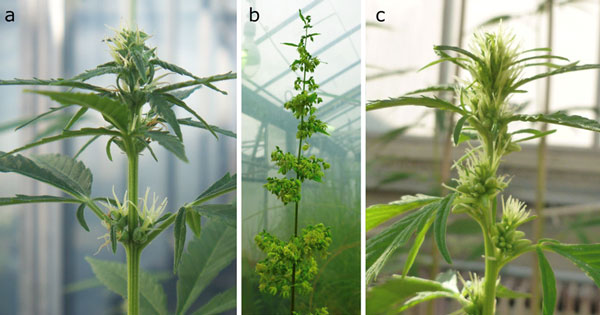
Figure 2. Sex expression is shown across the monoecious (a and b) and diecious hemp plant (c). Photo A shows a female plant, B is a male plant, and C is a plant acting as a monoecious plant with both male and female expression. Photos used with permission.
Management Practices
Management practices for hemp vary slightly depending on whether the crop is grown for grain/dual‑purpose or for fiber (Table 1).
Table 1. Key planting considerations for grain/dual-purpose versus fiber hemp.
|
Planting Considerations |
Grain/Dual Purpose |
Fiber |
|
Seeding Rate |
30 lb |
40 – 65 lbs/ac |
|
Planting Depth |
½ inch |
½ inch |
|
Row Spacing |
8 – 15 inch |
8 – 15 inch |
|
pH |
5.0 – 8.0 |
5.0 – 8.0 |
Weed Control
Only one herbicide is currently labeled for use in hemp: Sonalan/Curbit, applied at 2 pints per acre. This product needs to be irrigated or rained in for best control. Observations at the Parr Research Center (Haysville, KS) denoted grass weed control with Sonalan, but pigweeds are poorly managed. It is a pre-emergent option for controlling both annual grasses and broadleaf weeds, but it will not offer season-long protection (Figure 3). Due to limited labeled products, going in with tight row spacing will grant hemp a better competitive nature.
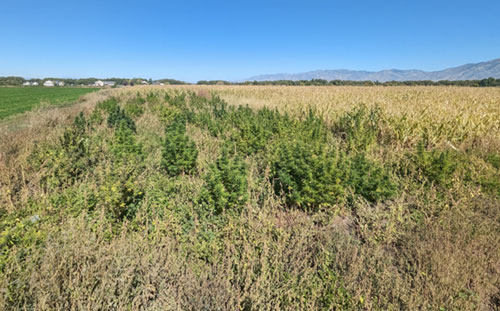
Figure 3. Cannabinoid hemp grown in Utah showing poor competition with weeds as preemergence herbicide loses efficacy over the season. Plant spacing in cannabinoid production is much larger than in fiber and grain hemp, but still shows the importance of canopy closure. Photo by Tina Sullivan, K-State Extension.
Soil Fertility
Hemp is known in many places as a “ditch weed”. This plant can handle a wide variety of soil types and conditions, likely due to its rooting capacity and strong ability to access nutrients (Figure 4). This crop tends to favor soils with pH above 6.2 with limited high pH concerns. With best management practices still being ironed out for this alternative crop and limited returns, limiting the fertility applications may not be a bad idea to keep weed pressure down. Current hemp returns are $0.70 per lb for grain and $0.18 per lb for fiber, meaning keeping input costs low is important for a crop with limited return on investment due to variable yields and unstable markets.
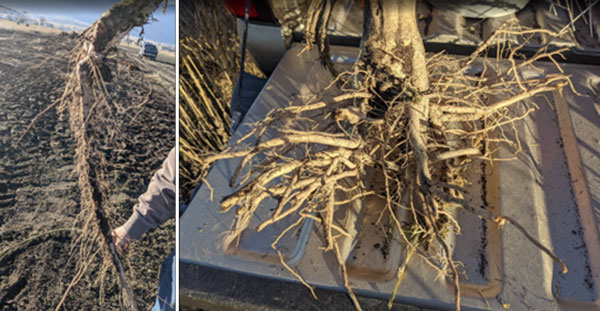
Figure 4. For an annual crop, hemp can have a massive root system for scavenging nutrients and moisture. Photos by Tina Sullivan, K-State Extension.
Harvesting
Grain hemp should be combine-harvested when plants are 70 – 75% mature, with the seed dried to 8% for storage. Leaving grain hemp in the field too long will lead to birds eating it similar to grain sorghum.
Fiber should be harvested around pollen shed or male flower senescence (less than 20% males flowering). Fiber harvest can be done via a swather or hand sickling, leaving the biomass in the windrows to ret for two to three weeks. Retting is the microbial process that breaks chemical bonds in the stem. Baling should occur when the material is less than 15% moisture and at 10% for storage.
Final Thoughts
While the hemp hype has settled due to high losses and limited agronomic knowledge, industry interest in hemp has increased. Hemp bedding, hemp for human nutrition, and hemp fiber production are a few accepted uses. More information is necessary to keep this crop growing, but many alternative crops in any system take time for an established market to occur.
Tina Sullivan, Northeast Area Agronomist
tsullivan@ksu.edu