Wildfires that burn growing crops or remove protective residue from cropland create immediate challenges: crop injury, elevated erosion risk, altered nutrient status, and difficult planting decisions. This article covers wheat injury assessment, options for fields left bare after wildfire, nutrient implications, soil behavior, and emergency tillage for wind erosion control.
Injury to Growing Wheat
Wheat in the jointing stage or beyond can be injured by fire or superheated air. This injury will be most severe on the edge of the field closest to the fire or super-heated air. It is not uncommon to have some injury to growing wheat on the edge of a field if the field is adjacent to a prescribed burn. The injury symptoms may be bleached or scorched leaves and possibly damaged growing points. The extent of injury from a wildfire depends on how quickly the fire moved through the field or around the field.
Research has found that the lethal high temperature for wheat is about 120°F (http://jxb.oxfordjournals.org/content/35/11/1603.short).
A wildfire can easily heat the air or the plants themselves to well over those temperatures, depending on how close the fire is to the wheat, possibly resulting in irreparable damage to the affected plants.
Wildfire injury to wheat will most likely be quite variable through the field. The only way to accurately assess any possible injury is to slice open the stems and examine the growing points 10-14 days after the fire. As with freeze damage, if the growing point is green and turgid (crisp) and light green, it is fine. If it is white, off-white, or yellowing and soft, it is damaged. If there was extensive damage, the ability of the wheat to recover will be similar to the ability to recover from spring freeze injury.
Managing Burned Stubble or Residue
In many instances, fields of wheat or row-crop residue intended for seeding are left barren after a wildfire. There are many considerations and options for managing these fields moving forward. The first consideration should be how to protect the field from potential wind and water erosion by the use of emergency tillage (details are presented later in this article).
Farmers generally have several options:
- Summer-fallow the land until seeding of the winter wheat crop
- Plant a summer cash crop
- Plant a cover crop. Options may be limited by timing and the amount of precipitation received after the wildfire.
Summer-Fallow. Summer-fallowing the land is a straightforward option, but with zero residue present to buffer erosion by wind and water, care should be taken to use tillage operations that maintain surface roughness as long as possible up until seeding time.
Planting a summer cash crop. As wildfires typically follow long periods without precipitation, it’s likely that little soil water exists in the profile. While profile water at planting is important, data from long-term rotation studies in western Kansas have consistently shown that surface residue plays a very important role in maximizing the utilization of in-season precipitation. The reduced precipitation use efficiency, combined with low levels of profile water, makes cropping with a summer cash crop a particularly risky option. The larger challenge is that, if the cash crop fails and produces little above-ground biomass, the producer is entering the typically dry, windy winter quite vulnerable to further wind erosion.
Planting a cover crop. If sufficient precipitation is received to establish a stand, a producer may consider a cover crop to grow some biomass as soon as possible and potentially serve as a feed resource if enough growth occurs. In general, a farmer should select species that produce the most biomass per inch of water consumed. For cool-season species, this would include spring triticale and oat. Millets and sorghums are warm-season species. In the early spring, a producer may want to plant a blend of cool-season and warm-season species to get some cover more quickly from the cool-season crop, followed by higher amounts and more durable residue from the subsequent warm-season crop.
Keep in mind that soil temperatures will be warmer with no residue, so millets and sorghums will generally germinate earlier than what is considered normal at a typical planting date. If planting a blend, it’s important to select a planting depth that both places the seed in moisture and is acceptable for the species selected.
Some potential cover crops, such as oats and some millets, will require shallower seeding than other potential species. At the time of this writing, most producers should consider moving towards seeding cool-season covers. If a producer has access to a hoe-drill, that method of seeding may offer some benefits for erosion reduction, protection of the emerging cover crop, and -- if done on the contour of sloping land -- reduction of soil erosion by runoff.
Nutrient considerations
About half of the nitrogen and sulfur in the crop residues are lost to combustion during a fire. In extremely hot fires (the occurrence of white ash is an indicator), more than 25% of the phosphorus in the residue may be lost. Remaining nutrients would be in the ash, which can easily be lost from the field by wind or runoff. If nitrogen had been surface-applied and was not yet incorporated by precipitation or tillage, it is likely that a significant portion will have been lost. It will take time for nutrient cycling to return to normal. It’s recommended that soil sampling be conducted prior to the next cash crop and thereafter to detect and address deficiencies.
Erosion Risk After Wildfires
The number one issue regarding the impact of a wildfire on soil quality is susceptibility to erosion from water or wind. Past research, mainly on forest soils after a fire, indicates there is nothing to worry about regarding long-lasting chemical or biological effects in the soil. Managers and landowners may notice a hardening of the soil surface, but there is no reason to be concerned that the fire will make the soil hydrophobic (reduced water infiltration). That can happen in forest soils, but is unlikely in grassland soils. Any surface hardening caused by the wildfire will likely be shallow and temporary.
If the vegetative cover on the soil surface is completely burned off, this increases the potential for wind erosion during the early spring months, when wind erosion rates are often at their highest (Figure 1).
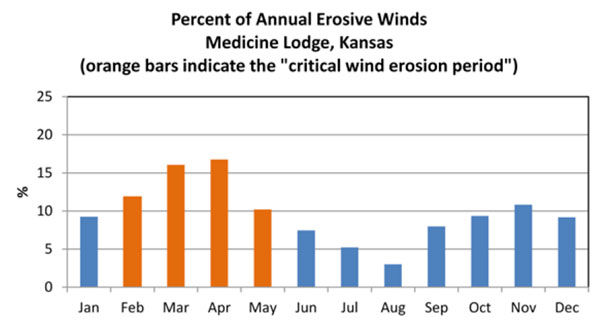
Figure 1. Percent of annual erosive winds by month for Medicine Lodge, KS. Source: John Tatarko, USDA-ARS Agricultural Systems Research Unit, Ft. Collins, Colo.
Vegetation growth within a week or two of the fire would reduce the potential for erosion problems. However, this isn’t likely with February fires on warm-season grasslands. When vegetation or residue cover is insufficient, ridges and large soil clods (or aggregates) are frequently the only means of controlling erosion on large areas. In grasslands, seeding a temporary cover crop is another option for small areas, if the permanent grasses and forbs do not seem to be growing back with the onset of the growing season and receiving some moisture. If there is no soil moisture, however, planting a cover crop will likely fail.
Using Emergency Tillage to Control Wind Erosion
One option for cropland or smaller tracts of grassland left bare after wildfire is to roughen the soil surface using ridges and clods. A rough, cloddy surface slows wind at ground level and traps moving soil particles, reducing erosion. While this approach is not practical on large rangeland acreages, it can be very effective on cropland and smaller burned areas. Surfaces that are both ridged and cloddy provide the best wind protection.
Crosswind ridges, created by tilling or planting across the prevailing wind direction, are particularly useful. In Kansas, early‑spring winds predominantly come from the south, so ridges should generally run east–west to protect against both southerly and northerly winds. When burned cropland borders burned grassland, placing ridges along field edges can help prevent soil from drifting into fencerows or roadside ditches.
In fields with terraces, continuous east–west or southeast–northwest passes may not be possible. In these cases, tillage can be used to roughen the terrace faces most exposed to prevailing winds, with additional contour passes between terraces if blowing persists. Contour tillage on terrace backsides can also reduce water‑driven soil movement until vegetation or residue is re‑established.
Tillage tools create ridges and depressions that disrupt wind flow. Depressions help capture saltating particles (soil grains that bounce along the surface) and can contribute to erosion further downwind (Figure 2). However, ridges also protrude higher into turbulent air and face stronger wind forces, so it is important that the clods on top of ridges are large and durable enough to resist breakdown. Ridges made of sand, for example, provide little benefit because sandy clods erode quickly.
Clod‑forming tillage is most effective when it produces aggregates large enough to resist wind and withstand abrasion throughout the erosion season. Over time, as smaller particles blow away or are trapped, a surface with strong clods becomes increasingly stable or “armored.” The longevity of this protection depends on clod durability and wind variability.
Soil texture strongly influences the ability to form stable clods.
- Sandy and coarse‑textured soils lack the silt and clay needed to bind particles together and are therefore highly susceptible to erosion.
- Loams, silt loams, and clay loams tend to form stronger aggregates.
- Clays and silty clays can break into fine granules that are still prone to movement.
Adequate soil moisture is also important. If the soil is extremely dry, clods may not form well, and deeper tillage might be needed to bring up more cohesive material.
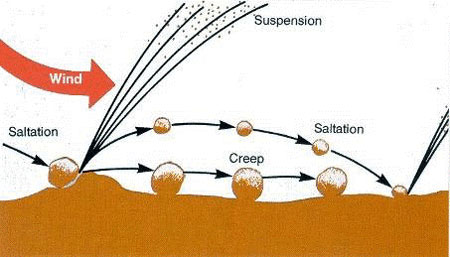
Figure 2. Soil particles can move through saltation, creep, and suspension. Source: Principles of Wind Erosion and Its Control, K-State Research and Extension publication MF-2860: http://www.bookstore.ksre.ksu.edu/pubs/MF2860.pdf
Emergency Tillage Equipment Selection
Selecting the proper tillage implement for emergency tillage is critical to achieving meaningful, lasting results. Chisels, aggressive rippers, and listers are useful implements when they can be run deep enough to bring large clods to the surface. Any type of rolling basket or firming wheels on a ripper or harrows on a chisel should be completely raised to maximize surface roughness. Sweep (blade) plows, field conditioners, discs, and vertical tillage machines are not useful in reducing wind erosion and in many instances can make the situation worse by exposing even more fine, erodible, soil particles than would be exposed on a post-fire soil surface.
For more information, see:
Principles of Wind Erosion and Its Control, K-State Research and Extension publication MF-2860 at: http://www.bookstore.ksre.ksu.edu/pubs/MF2860.pdf
Emergency Wind Erosion Control, K-State Research and Extension Publication MF-2206 at: https://bookstore.ksre.ksu.edu/pubs/mf2206.pdf
DeAnn Presley, Soil Management Specialist
deann@ksu.edu
Augustine Obour, Soil Scientist, Agricultural Research Center-Hays
aobour@ksu.edu
John Holman, Southwest Research-Extension Center Agronomist
Jholman@ksu.edu
Lucas Haag, Agronomist-In-Charge, Tribune
lhaag@ksu.edu
Chip Redmond, Kansas Mesonet Manager
chrisopherredmond@ksu.edu