Introduction
While targeted spraying has been widely adopted in fallow systems, recent advances in computer vision and machine learning have made site-specific weed management (SSWM) possible in cropped fields. These “green-on-green” systems are more complex because they must distinguish weeds from crop plants, but they offer significant potential for reducing herbicide use while maintaining effective weed control.
Precision in-crop weed control
Multiple targeted sprayer systems with automatic detection and actuation controls have been recently commercialized for in-crop weed control, with excellent performance for SSWM. In general, these systems use cameras that can accurately classify and localize weeds and crop plants to activate nozzles and precisely spray weeds in the crop. Examples include the See & Spray™ Technology from John Deere (https://www.deere.com/en/sprayers/see-spray/), Greeneye™ Technology (https://greeneye.ag/), and the ONE SMART SPRAY (https://www.onesmartspray.com/) system, which is a joint venture of Bosch and BASF Smart Farming.
Cameras and processors are mounted on the boom and utilize the combined power of computer vision and machine learning to detect and distinguish weeds from crop plants (Figure 1). The accuracy of the target spray is improved by boom height control systems. Different systems have explored how to use dual-boom, dual-tank, and plumbing systems to allow simultaneous broadcast and targeted applications in one pass through the field.
- Single-tank systems can target-apply all herbicides, including residual herbicides, specifically to weeds or apply only postemergence herbicides in one pass.
- In dual-tank systems, the first boom can apply residual or broadcast herbicides while the second boom can target-apply to emerged weeds in one pass.
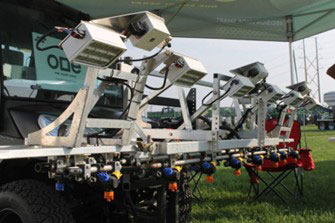
Figure 1. Lighting units, cameras and nozzles on the ONE SMART SPRAY sprayer system. Image courtesy ONE SMART SPRAY (https://www.onesmartspray.com/).
Detection performance and sensitivity tradeoffs
Sensitivity settings determine the confidence level of weed detection. Lower thresholds increase the probability of detecting weeds but may increase herbicide use. Higher thresholds increase herbicide savings but increase the risk of missing weeds. These settings allow operators to choose between an efficacy-focused approach (lower threshold) and a savings-focused approach (higher thresholds). A fallback mode enables the machine to transition between targeted applications and broadcast applications whenever the boom encounters issues, including high weed pressure.
Herbicide and cost savings
Key factors that will help achieve effective weed control and maximize herbicide savings when using targeted spray technologies include the sensitivity setting, overall lower weed pressure, the use of pre-emergence residual herbicides, and early-POST applications. The ability of the cameras to detect very small areas of green plant material allows for more herbicide savings. Increased cost savings will generally be associated with fields that have less weed pressure at the time of spraying. Therefore, fields with strong and effective soil-applied residual herbicide control will offer greater potential for herbicide savings with fewer weeds to target during the early-POST application pass.
Research from K-State in 2023 in Manhattan evaluated the impact of four herbicide programs and four sensitivity levels on the cost savings of the ONE SMART SPRAY system in corn and soybean. The herbicide programs were composed of:
- A two-pass “Residual-at-plant” approach with a fallow application including simultaneous broadcast soil-residual and targeted foliar herbicides, followed by an in-crop targeted application of foliar herbicides only.
- A two-pass “Overlapping-residual” approach with a split application of soil-residual herbicides for both fallow and in-crop timings as well as targeted foliar herbicides at each timing.
- A “Spike” approach in which a base recommended rate of foliar herbicide was broadcast for both fallow and in-crop timings, with the goal to control small, undetected weeds, and superimposed with a targeted spike application to increase the rate of the same herbicides when weeds were detected and to increase the likelihood of control.
- A two-pass “Spot-spray-only” approach with targeted applications of foliar herbicides in both fallow and in-crop timings, with no broadcast soil-residual herbicides applied.
The four sensitivity levels were: traditional Broadcast, Efficacy (with some false positives), Balanced, and Savings (with no false positives). The “as-applied maps” generated by the sprayer, showing when the nozzles are turned on and off, can be used to determine the percentage of each field/area that was actually sprayed.
Results of research on cost savings
For both corn and soybean, the three detection thresholds resulted in lower costs than the corresponding Broadcast application across all herbicide programs (Figure 2). The Spot-spray-only (SS Only) program with all three SS detection thresholds cost less than the Residual-at-plant, Overlapping-residual (because of broadcast soil-residual herbicides), and Spike (because of broadcast foliar herbicides) programs. However, poorer weed control was observed with the SS Only program.
The average savings across the three detection thresholds was $50 per acre for soybean but only $17.41 per acre for corn compared to broadcast. The difference in savings between the soybean and corn studies could be attributed to weed pressure and crop growth stages. The soybean field had less weed pressure than the corn field, resulting in fewer detections and less frequent herbicide applications. Also, the in-crop application to taller corn plants (at the V5 growth stage) had corn leaves that reduced the space visible between rows, led the ONE SMART SPRAY sprayer to default to a broadcast application when interrow space could not be clearly observed.
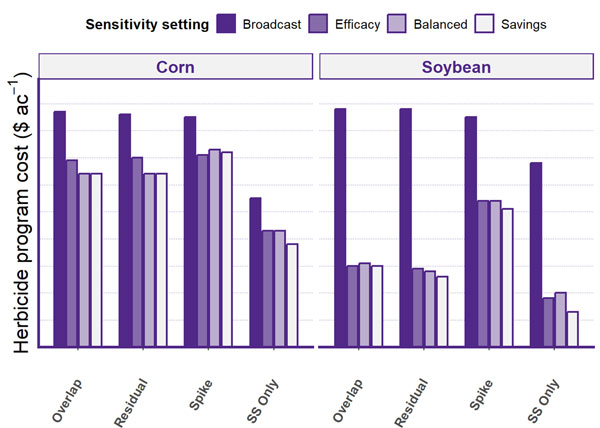
Figure 2. Herbicide program costs for corn and soybean when comparing four herbicide programs: [Overlap (Overlapping residual), Residual (Residual at-plant), Spike, SS Only (Spot-spray-only)] and four sensitivity levels of the ONE SMART SPRAY system. Research conducted in Manhattan, KS, in 2023.
Take-home message
Targeted in-crop spraying systems can reduce herbicide use. Additionally, this research highlights that residual herbicides and multiple passes of foliar herbicides are still important when using this technology. Growers would benefit from using two-boom, two-tank targeted sprayers for these simultaneous applications. Incorporating integrated weed management principles with this technology remains very important.
Jeremie Kouame, Weed Scientist – Agricultural Research Center, Hays
jkouame@ksu.edu
Anita Dille, Professor - Weed Ecology
dieleman@ksu.edu
Tags: herbicide weed management precision agriculture targeted spraying