The cotton jassid (Amrasca biguttula), also known as the two-spot cotton leafhopper, is an invasive insect pest native to Asia and a serious economic pest of cotton in India that has recently expanded across the southern United States. While not yet confirmed in Kansas or Oklahoma, its rapid spread in 2025 across the Southeast and its detection in nearby regions (Mid-South) raise concern about potential movement into the Southern Plains. Kansas and Oklahoma cotton acres could be vulnerable to this pest in 2026. The cotton jassid may spread through weather events, movement of plant materials, or natural migration. Early awareness and proactive scouting will be critical to minimizing potential impacts.
Identification
Accurate identification is critical, as cotton jassid can be confused with other leafhopper species, such as the corn leafhopper. Adult jassids are small, measuring approximately 1/8 inch in length, with a wedge-shaped, pale green body (Figure 1). A distinguishing feature is the presence of a black spot on each forewing, often accompanied by two spots on the head. Nymphs are even smaller, wingless, and pale green in color. Both life stages exhibit a characteristic sideways movement when disturbed, which can help differentiate them from other insects.
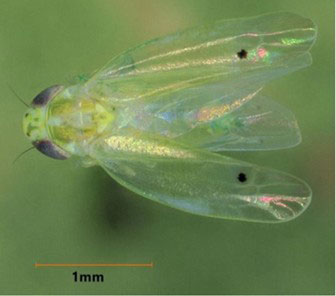
Figure 1. Adult cotton jassid (also called two-spotted cotton leafhopper). A black spot on each forewing, often accompanied by two spots on the head, is a distinguishing mark. Photo Courtesy of Dr. Isaac Esquivel, University of Florida.
Biology and Life Cycle
Cotton jassid females lay eggs within leaf veins and midribs, where they hatch in about one week. The nymphal stage typically lasts 5-16 days (Figure 2), depending on environmental conditions. Adults may live for up to five weeks, allowing for multiple overlapping generations. In warmer climates, the pest can complete numerous generations per year. For example, in India, generation time ranges from 15 to 46 days, allowing up to 11 generations per year. In Kansas, conditions may limit population growth compared to tropical regions, though reproduction during the summer months could still lead to economically significant infestations.
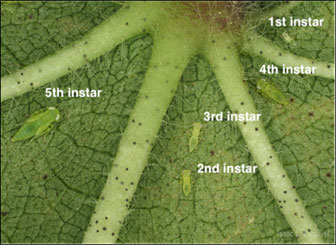
Figure 2. Cotton jassid nymphs on the underside of a leaf. Cotton jassids will progress through several instars before becoming adults. Photo courtesy of Dr. Isaac Esquivel, University of Florida.
Host Range
One factor contributing to the potential establishment of cotton jassid in Kansas is its broad host range. In addition to cotton, it can feed on crops such as soybean, peanut, sunflower, and potato, as well as okra and various ornamental plants, namely hibiscus. The presence of several of these crops in Kansas production systems, especially soybean and sunflower, may provide suitable hosts that allow populations to persist and spread.
Crop Injury and Symptoms
Both nymphs and adults feed on the undersides of leaves by extracting plant sap and injecting toxic saliva. This feeding results in a condition commonly referred to as “hopperburn” (Figure 3). It is essential to understand that this damage is not related to a virus or other pathogen (e.g., corn stunt). Early hopperburn symptoms include leaf curling, particularly downward cupping, followed by yellowing that progresses to bronzing or reddening. As damage intensifies, leaf margins may become necrotic, leading to premature defoliation. Severe infestations may lead to stunted plant growth, shedding of squares and bolls, and significant yield reductions. In heavily affected regions, yield losses have been reported to reach 50%.
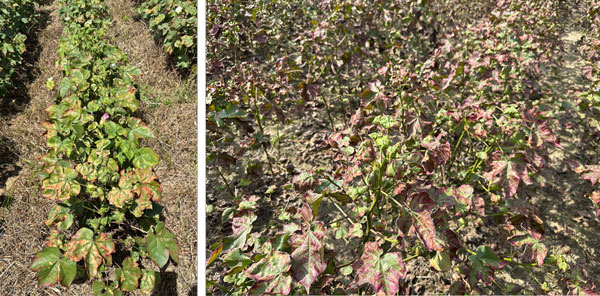
Figure 3. Hopperburn symptoms, including advanced leaf reddening. Photo courtesy of Dr. Scott Graham, Auburn University.
Look-Alike Issues
The symptoms of cotton jassid injury can resemble those caused by other factors, such as potassium deficiency or diseases like Verticillium wilt. For this reason, proper diagnosis requires confirmation of the insect’s presence on the undersides of leaves. Without evidence of the pest, other causes of plant stress should be considered. As a reminder, cotton jassid injury is not associated with any vectored pathogen, so testing plant material cannot be used to confirm cotton jassid in the absence of the actual insect.
Scouting Recommendations
Effective management of cotton jassid begins with regular and thorough scouting. Producers should focus on examining the undersides of leaves, particularly those located at the third to fifth node from the top of the plant. Scouting should begin early in the growing season and become more frequent during periods of hot, dry weather, which can favor population development. Infestations often begin along field margins before spreading inward, so these areas should receive particular attention.
Economic Threshold
Preliminary economic thresholds developed in the southeastern United States suggest that treatment may be justified when 1 to 2 nymphs are present per leaf, and hopperburn symptoms are evident. The combination of insect presence and visible plant injury is important, as it helps distinguish cotton jassid from other leafhopper species that may not cause economic damage.
Management Considerations
Although research is still ongoing, several insecticides have shown effectiveness against cotton jassid in Georgia and Alabama. These include products such as Bidrin, Sivanto Prime, Sefina, and Carbine. Observations in the Southeast have suggested that treating field margins was ineffective for managing cotton jassid. Whole-field applications are warranted when threshold populations are identified. However, Kansas producers are encouraged to avoid unnecessary applications until local thresholds and recommendations are better established. Integrating control measures within an overall integrated pest management program and preserving beneficial insect populations should remain priorities.
To receive timely updates on cotton jassid activities in the Southern Plains, sign up for special alerts from Texas A&M AgriLife Extension by texting Cotton to (833)717-0325 or following this link: https://www.texasinsects.org/agriculture-audio-updates-home.html.
Logan Simon, Southwest Area Agronomist – Garden City
lsimon@ksu.edu
Anthony Zukoff, Extension Entomologist – Garden City
azukoff@ksu.edu