Adjuvants are commonly used to increase the efficacy of postemergence herbicide applications. There are a few key types of adjuvants, including:
- nonionic surfactants (NIS)
- crop oil concentrates (COC)
- methylated seed oils (MSO)
- nitrogen fertilizers such as ammonium sulfate (AMS) or urea ammonium nitrate (UAN).
The success of many herbicide applications depends on selecting the correct adjuvant, which is always described on the herbicide label. For example, COC is often recommended with clethodim (Select), MSO with tembotrione (Laudis), MSO plus AMS with saflufenacil (Sharpen), and NIS with mesotrione (Callisto). In some cases, using the wrong adjuvant may reduce herbicide efficacy or increase crop injury. One important example of this is glyphosate (Roundup) when mixed with COC or MSO.
High Surfactant Oil Concentrate (HSOC) adjuvants were developed for use in tank mixes that include herbicides that require an oil adjuvant and glyphosate. HSOC adjuvants are oil-based, containing 20% to 50% surfactant and a minimum of 50% of oil. An HSOC can use either COC (HSPOC) or MSO (HSMOC). The surfactant component of HSOC improves droplet spread and disperses oil-soluble compounds in water while the oil component increases absorption across the leaf cuticle. The overall effectiveness of an HSOC on hydrophilic (water-soluble) and lipophilic (oil-loving) herbicides depends on the properties of the oil and surfactant, and the oil-to-surfactant ratio. Research conducted in North Dakota showed that glyphosate plus dicamba or tembotrione provided greater control of several indicator species, on average, with HSMOC compared to HSPOCs evaluated (Figure 1).
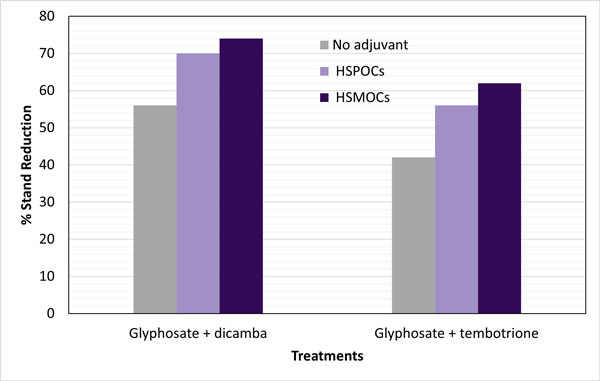
Figure 1. Average species control expressed as stand reduction (%) for glyphosate + dicamba and glyphosate + tembotrione applied without adjuvant or with average HSPOC and HSMOC treatments. Adapted from Wirth and Zollinger (2018), who reported few differences among individual products within HSPOC and HSMOC groups; therefore, group averages are presented here for clarity.
Always follow label requirements and recommendations for adjuvant use. If the herbicide label does not specify HSOC use directions, HSOC adjuvants should generally be applied at half the labeled rate of COC or MSO, typically around 0.5 % v/v, to minimize the risk of crop injury.
For additional information about adjuvants, see Adjuvants with Herbicides. When and Why They Are Needed. For more detailed information about herbicides, see the “2026 Chemical Weed Control for Field Crops, Pastures, and Noncropland” guide online or check with your local K-State Extension office for a paper copy.
The use of trade names is for clarity to readers and does not imply endorsement of a particular product, nor does exclusion imply non-approval. Always consult the herbicide label for the most current use requirements.
Yasir Parrey, Graduate Research Assistant
Sarah Ganske, Weed Management Specialist
slancaster@ksu.edu
Patrick Geier, Weed Scientist - Southwest Research & Extension Center, Garden City
pgeier@ksu.edu
Jeremie Kouame, Weed Scientist – Agricultural Research Center, Hays
jkouame@ksu.edu
Tags: herbicides post-emergence adjuvant