Ammonium sulfate (AMS) is a common additive used in herbicide applications, and much has been written about its benefits for conditioning hard water when using several weak acid herbicides, such as 2,4-D, glufosinate, and imazamox. Glyphosate is the most common example of these herbicides, and an article from last spring discussed the use of AMS as a water conditioner. However, AMS offers other benefits when added to a spray solution, and this article discusses some of those, as well as when AMS should not be added to the tank.
Understanding how AMS works in a spray solution
When added to water, AMS dissociates into ammonium ions (NH4+) and sulfate ions (SO42-). The sulfate ions are responsible for tying up the hard water cations, such as calcium, iron, sodium, and magnesium, common in our water. The ammonium ion can bind with the molecules of the weak-acid herbicides, resulting in greater herbicide uptake. The combined ammonium-herbicide molecule passes through the waxy leaf surface more easily than the herbicide molecule alone. Because of this increased plant uptake, AMS is often recommended when weeds are stressed by environmental conditions. Additionally, all weed species have cations (positively charged ions) present on their leaf surfaces, and the number of cations varies depending on species and growing conditions. Sulfate ions, which are negatively charged, in the spray water can bind to these cations, preventing them from tying up the herbicide molecules. Another benefit of AMS is that it acts as a humectant. That is, it absorbs moisture from the surrounding air, slowing the drying time of the spray droplet. The increased drying time allows more of the herbicide in the droplet to be absorbed by the plant.
How much AMS should be added?
AMS rates are normally expressed as a weight per spray volume or percent of the spray volume on a weight per volume basis: for example, 8.3 pounds AMS per 100 gallons of spray solution (1% w/v) or 17 pounds per 100 gallons (2% w/v). Some herbicide labels, such as the glufosinate products, recommend adding AMS on a per-acre basis, often 1.5 to 3 pounds per acre. Figure 1 shows the relationship between AMS concentrations and sprayer application volume. When sprayer application volumes are high (20 gpa), the 17 lb/100 gallon rate of AMS is sufficient to achieve the 3 lb/A rate. However, as application volume decreases, more than 17 lb/100 gallons are needed to meet the 3 lb/A requirement.
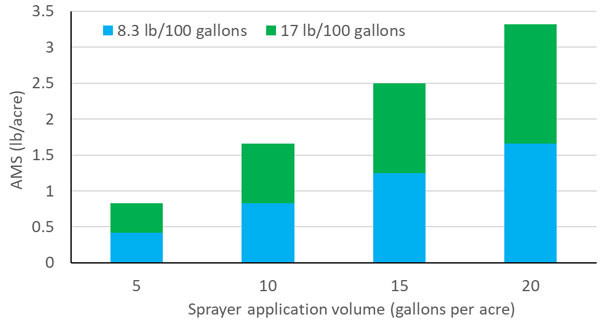
Figure 1. The influence of application volume on pounds of AMS per acre at two AMS concentrations (8.3 lb/100 gallons and 17 lb/100 gallons). Graph by Pat Geier, K-State Extension.
An experiment at Garden City, KS, in 2025 examined the effect of increasing the AMS rate on glufosinate efficacy in corn. A low rate of Liberty Ultra (19 oz/A) was used to help separate differences among the AMS rates, and plots were sprayed at 19.4 gpa. A municipal water source containing 259 ppm of total dissolved solids served as the carrier. Calculations showed that 1.3 lb AMS/100 gallons (0.15% w/v) was sufficient to overcome hardness in this water, and was well below the lowest AMS rate evaluated.
Summary of results (Figure 2):
- Without any AMS, Palmer amaranth and kochia control was less than 70% at 21 days after treatment.
- Control of both species increased as the AMS rate increased from 0.75 to 3.0 lb/A.
- An AMS replacement, included for comparison purposes, was no more effective than Liberty Ultra alone when added at the recommended label rate.
This data shows the importance of AMS in maximizing control over these two species.
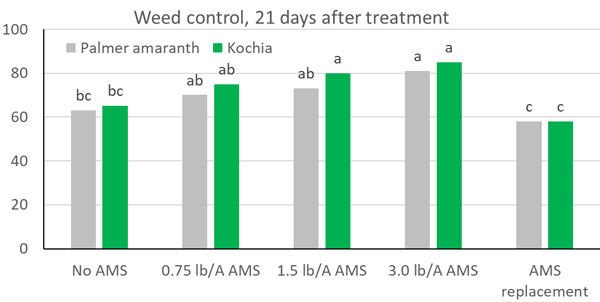
Figure 2. Weed control (% controlled) with glufosinate as affected by AMS concentrations (pounds per acre). Means with the same letters within species are not significantly different. Graph by Pat Geier, K-State Extension.
Are AMS replacements effective?
Many AMS replacements are currently on the market, and these products vary widely in their chemical composition. These products offer greater convenience in mixing and handling than dry AMS. However, it is important to note that these products typically cost more than dry AMS, and research has shown that many (but not all) are less effective or no more effective than dry AMS. The maximum use rate of the product may be required to get an AMS rate equivalent to 8.3 lb/100 gallons. In these cases, it is imperative that the producer knows how much AMS is in the AMS replacement and ensures that it is enough to maximize weed control.
Know the rules – read the label
It is important to know when AMS should not be added to the tank. For example, the EPA recently registered three dicamba products (Engenia, Tavium, and Stryax) for postemergence weed control in dicamba-tolerant soybean and cotton. Due to the increased potential of off-target movement of the dicamba, AMS is prohibited from being added with these products. As always, it is important to read the herbicide label to determine if and how much AMS is needed to maximize weed control in a specific situation.
More information regarding the use of AMS can be found in the 2026 K-State Chemical Weed Control Guide SRP-1194.
Patrick Geier, Weed Scientist - Southwest Research and Extension Center, Garden City
pgeier@ksu.edu
Jeremie Kouame, Weed Scientist - Agricultural Research Center, Hays
jkouame@ksu.edu
Sarah Lancaster, Weed Science Extension Specialist
slancaster@ksu.edu
Tags: anhydrous ammonia herbicide application spray water AMS