This World of Weeds features wild garlic (Allium vineale) and wild onion (Allium canadense). These weeds are popping up in yards and fields in Kansas. From a distance, they may look like a clump of grass, but they definitely smell worse.
Ecology
Wild garlic and wild onion are both perennial plants in the Lily family that primarily reproduce from underground bulbs. They grow actively in late winter and early spring, making them problematic in small grains and pastures, but not summer crops (Figure 1). Wild garlic and wild onion are not very competitive; however, they can cause off flavors in dairy and grain products, reducing their value. If consumed in large quantities, they can be toxic to cats, dogs, and horses. Wild garlic was introduced from Europe and is found primarily in eastern Kansas, while wild onion is native to the US and found throughout most of the state.
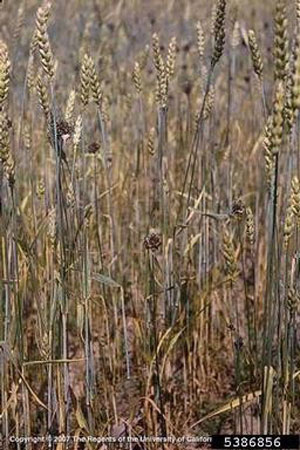
Figure 1. Wild garlic growing in a wheat field. Photo: Joseph M. DiTomaso, University of California - Davis, Bugwood.org
Identification
Wild garlic and wild onion can be challenging to tell apart. A summary of some key characteristics is listed in Table 1.
Table 1. Key identifying features of wild garlic and wild onion.
|
|
Wild garlic |
Wild onion |
|
Distribution |
Eastern 1/3 of KS |
Statewide |
|
Leaves |
Hollow, round, 8 to 24 inches long |
Solid, flat, 4 to 12 inches long |
|
Scape |
Up to 35 inches |
Up to 24 inches |
|
Flowers |
Small, greenish white to pink |
White or pink |
Both wild garlic and onion grow from bulbs that produce fibrous roots. The bulb of wild onion has a fibrous outer coating, which wild garlic does not have.
Leaves of both plants are thin and waxy. Wild garlic leaves are 8 to 24 inches long, nearly round, and hollow. Wild onion leaves are 4 to 12 inches long, flat, and keeled (they have a ‘canoe’ at the tip). Leaves are not hollow.
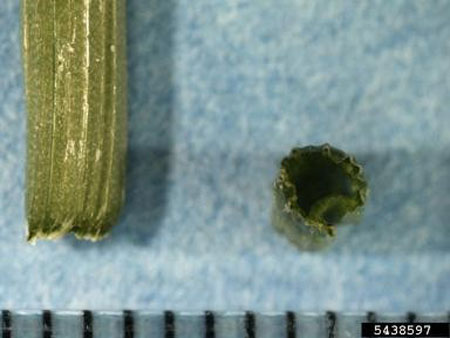
Figure 2. Wild garlic leaves are round and hollow. Photo credit: Ohio State Weed Lab, The Ohio State University, Bugwood.org
Flowers, when produced are formed in round clusters at the top of a scape (leafless flower stalk) that is up to 35 inches tall in wild garlic, about 20 inches tall in wild onion (Figure 3). Flowers have 6 petals and are usually replaced by bulblets. Wild garlic flowers are small and greenish white to pink on short stems (Figure 4). Wild onion flowers are white to pink in color. Seeds are seldom produced by either species. Wild garlic seeds are flat, black, and wrinkled; wild onion seeds are round with a ridge and shiny black in color.
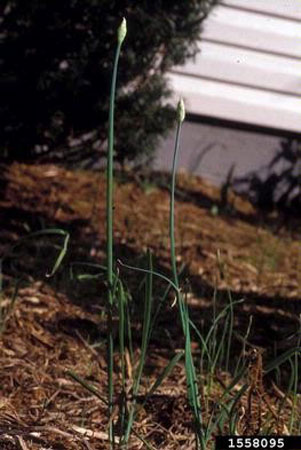
Figure 3. Wild onion with flowering stem. Photo credit: Ohio State Weed Lab, The Ohio State University, Bugwood.org
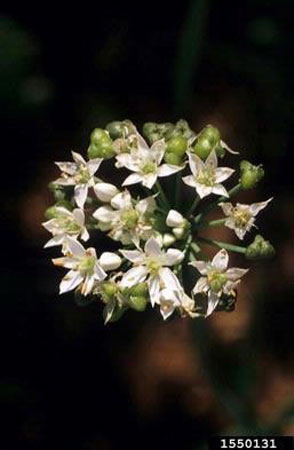
Figure 4. Wild garlic flowers Photo credit: Ohio State Weed Lab , The Ohio State University, Bugwood.org
Management
Postemergence applications of herbicides containing 2,4-D and dicamba are economical options for controlling or suppressing wild garlic and wild onion. However, they can injure wheat crops, especially if 2,4-D is applied too early or dicamba is applied too late. Harmony Extra has a wider application window in wheat but generally provides better control of wild garlic than wild onion. Combining 2,4-D and Harmony Extra can provide better control.
Chemical control of wild garlic and wild onion can be difficult because their waxy leaf surface and upright growth habit limit herbicide absorption. Integrated weed management practices can suppress wild garlic and wild onion. Crop rotation and maintaining competitive crops can disrupt the life cycle. Frequent tillage from fall through late spring can deplete underground reserves, particularly under warm, dry soil conditions. However, tillage may also spread bulbs to new areas.
For more information, see the “2026 Chemical Weed Control for Field Crops, Pastures, and Noncropland” guide available online at https://bookstore.ksre.ksu.edu/pubs/SRP1194.pdf or check with your local K-State Research and Extension office for a paper copy.
The use of trade names is for clarity to readers and does not imply endorsement of a particular product, nor does exclusion imply non-approval. Always consult the herbicide label for the most current use requirements.
Sarah Lancaster, Extension Weed Management Specialist, Manhattan
slancaster@ksu.edu
Yasir Parrey, Graduate Research Assistant
yasir1@ksu.edu