The recent overnight cold temperatures on April 17-19 were enough to cause freeze damage to winter wheat in parts of Kansas, especially in the western and north-central regions. The actual freeze damage will be region-specific, depending on crop growth stage and minimum temperatures. Some regions had the worst combination of temperatures and crop growth stage, and within each region, field-specific factors, such as crop density and residue level, also contributed. While there is nothing we can do immediately, growers can prioritize the fields they sample for freeze-damage symptoms based on conditions more likely to result in freeze damage.
In this article, we discuss the low temperatures across the state and the individual conditions that might help growers prioritize which fields to sample and which injury symptoms to look for.
How cold did it get?
Cold temperatures across western Kansas ranged from 24°F in the larger valleys to the freezing mark in higher and more open regions. These cold temperatures spanned the overnight hours of Friday into Sunday morning (April 17-19). The following map (Figure 1) shows cold temperatures and the duration of time during which temperatures were below freezing. According to the K-State Spring Freeze Injury to Kansas Wheat publication, the approximate injurious temperatures for boot and heading wheat are two hours at 28 and 30°F, respectively. These are not hard numbers, as many factors influence freeze injury.
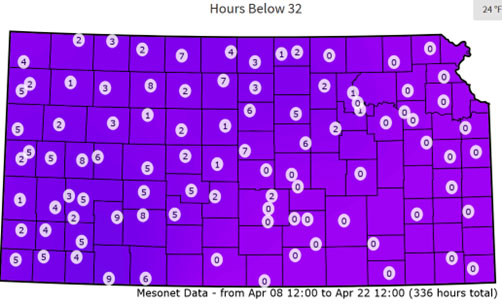
Figure 1. Duration in hours of below freezing temperatures, 32°F, for April 8 through April 22, 2026. Maps generated by Kansas Mesonet.
Field conditions that can affect the potential for freeze damage
Density of the stand and condition of the plants. If the stand is thick, that will tend to reduce the extent of freeze damage as the warmth of the soil will radiate up into the canopy. On the other hand, well-fertilized succulent wheat has often sustained more freeze injury than wheat that is not as well fertilized. Thin stands are at greater risk of injury because air can penetrate them more easily. If the plants were wet before the freeze, a coating of ice may form, protecting the growing point to some extent. However, if temperatures drop too low, the cold will penetrate the ice.
Residue. No-till fields can often sustain more freeze damage because the residue acts as a blanket, preventing the soil's heat from radiating up into the plant canopy.
Soil moisture. There is often less freeze injury at a given temperature when soils are wet than when they are dry. Wetter soils tend to radiate a little more warmth than dry soils. On the other hand, drought-stressed plants tend to be more tolerant of cold injury, and their lower leaf water content tends to reduce the severity of freeze injury.
Wind speed. Windy conditions during the nighttime hours, when temperatures are at their lowest, will reduce heat radiating from the soil and increase the risk of injury.
Temperature gradients within the field (position on the landscape). Low spots in the field are almost always the first to have freeze injury. The coldest air tends to settle in the low areas, especially under calm wind conditions.
Injury symptoms to look for in the coming days
There are many possible scenarios after a freeze, and producers should not make any immediate decisions. 10 to 14 days of warm temperatures are needed to allow the wheat to resume growth and to properly assess freeze damage, which will depend strongly on the crop stage (Figure 2).
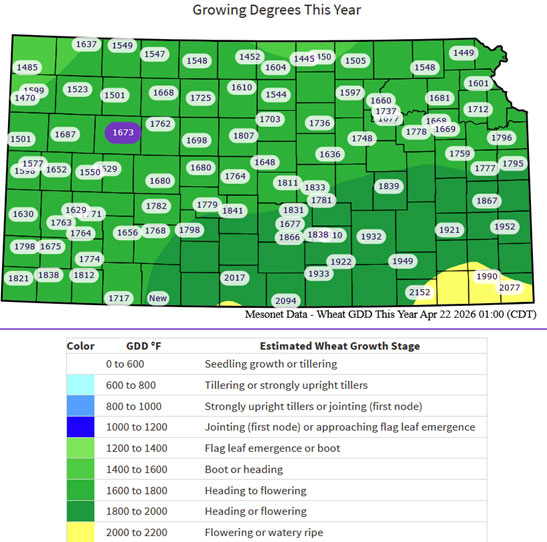
Figure 2. Estimated wheat growth stage on April 22 based on growing degree day accumulation in Kansas. Map generated by Kansas Mesonet.
Crop Stage: After Jointing, but Prior to Boot Stage
After the growing point has emerged above the soil surface and before the head enters the boot stage, the growing point and developing wheat head are wrapped in leaves, and the stem is forming below the growing point. During this time, the damaging temperatures are in the mid to upper 20s. Freeze damage may be seen on the leaves, on stems, on the growing point, and on the developing wheat head.
The stem should be split to look for damage to the growing point or the developing wheat head. A healthy growing point and wheat head should appear light yellow-green and turgid. A damaged growing point may appear mushy or dark yellow to brown colored (Figure 3). A damaged wheat head can appear underdeveloped, mushy, and off-colored.
If the growing point is damaged, that tiller will slow or stop growing. The leaf that is emerging from the whorl will start to turn yellow and then brown (Figure 3). The wheat head may not emerge at all, or it may emerge and be white, or portions of the head may be white.
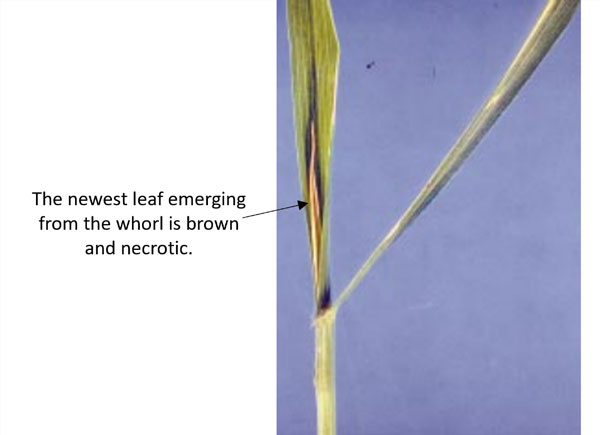
Figure 3. A yellow or necrotic leaf emerging from the whorl indicates the growing point is damaged. Photo from K-State Spring Freeze Injury to Kansas Wheat publication.
While you may see freeze-damage to the leaves, stems should also be examined for damage. This can appear as the stem's sides splitting open from ice freezing inside. Damage to the stem can result in lodging and decreased ability to carry water and nutrients to the growing point.
Crop Stage: Boot
At the boot stage, wheat can be injured if temperatures drop into the mid- to upper 20s for several hours. Injury is more likely when it occurs repeatedly and when it is windy at night. To detect injury, producers should wait several days, split open some stems, and look at the developing head. If the head is green or light greenish in color and seems firm, it will most likely be fine. If the head is yellowish and mushy, that’s a sign of freeze injury.
Freeze injury at the boot stage causes several symptoms when the heads are enclosed within the flag-leaf sheaths. Freezing may trap the spikes inside the boots, preventing them from emerging normally. When this happens, the spikes will remain in the boots, split out the sides of the boots, or emerge base-first from the boots.
Sometimes heads emerge normally from the boots after freezing, but remain yellow or even white instead of their usual green color. When this happens, all or part of the heads have been killed (Figure 4). Frequently, only the male parts (anthers) of the flowers die because they are more sensitive to low temperatures than the female parts (Figure 5). Since wheat is self-pollinated, sterility caused by freeze injury results in poor kernel set and low grain yield.
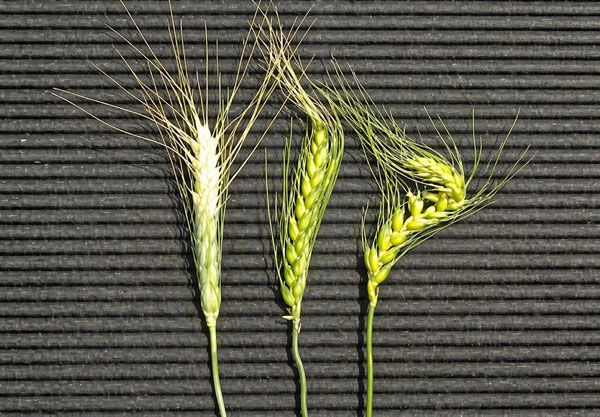
Figure 4. The twisted spike on the right was trapped in the boot and split out the side of the sheath. The awns of the middle spike were damaged while it was still in the boot stage. The spike on the left had partially emerged when freezing occurred, so only its upper portion was damaged. Photo from K-State Spring Freeze Injury to Kansas Wheat publication.
Some of the spikelets may be alive and healthy, dark green. At the same time, other spikelets on the same head are damaged (Figure 4). If a spikelet flowers normally and the kernels on that spikelet develop normally, then the head is at least partially viable and will produce grain (unless it freezes again, of course).
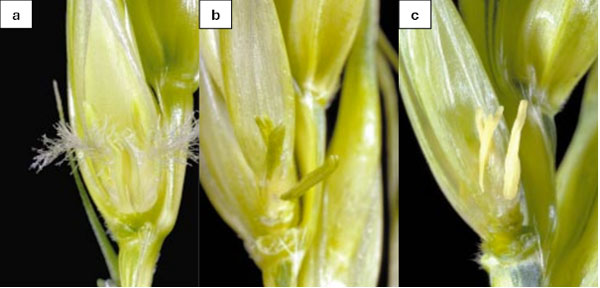
Figure 5. Each wheat floret contains three anthers. Healthy wheat anthers are trilobed, light green, and turgid before pollen is shed (a). Anthers become twisted and shriveled, yet remain their normal color within 24 to 48 hours after a freeze (b). If damaged, anthers become white after 3 to 5 days and eventually turn whitish-brown (c). The anthers will not shed pollen or extrude from the florets. Images from K-State Spring Freeze Injury to Kansas Wheat publication.
Crop Stage: Heading and Flowering
Wheat spikes typically emerge from the boots during the first three weeks of May; however, the Kansas wheat crop is about one month ahead of schedule in 2025. At these stages, most symptoms of freeze injury—such as sterility, leaf desiccation, and lesions on the lower stems—are similar to those seen in earlier growth stages. The most noticeable symptom, however, is usually chlorosis, or bleaching, of the awns (the beards of the wheat), resulting in a white color instead of the normal green (Figure 4).
Several days after exposure to freezing temperatures, a light green or white "frost ring" may appear encircling the stems one to two inches below the spikes. This yellowed, chlorotic tissue marks the point where the stem and the flag leaf meet at the time of the freeze. The frost ring may be present on both injured plants and those that show no other symptoms of injury. It typically does not interfere with nutrient transport from the plant to the developing grain. However, as the plants mature, the spikes may break at the frost ring, particularly in well-filled spikes and during windy conditions.
Symptoms of freeze injury during the flowering and heading stages of wheat are quite similar. However, the flowering stage is the most sensitive to freezing temperatures. Even small differences in temperature, duration of exposure, or other conditions can lead to significant variations in the level of injury. When wheat is exposed to freezing temperatures during the flowering stage, the male parts of the flowers are killed. After freezing, the anthers turn white and become desiccated or shriveled, losing their normal light green or yellow color (Figure 5).
Freeze injury at this stage can result in either complete or partial sterility, leading to void or poorly filled spikes due to the extreme sensitivity of the flowers. Flowering in wheat occurs from the florets near the center of the spikes to those at the top and bottom over a period of 2 to 4 days. If freezing occurs when florets at the center or at one or both ends of the spikes are still in a sensitive stage, those areas may end up void of grain. Conversely, grain may develop in other areas of the spikes, as flowering may not have started or could have already completed in those florets by the time of the freeze.
Take Home Message
- Freeze damage depends on crop stage, temperatures, and field conditions.
- Do not make immediate decisions. Allow 10-14 days for symptoms to appear.
- Check stems and developing heads to confirm injury.
- Focus scouting on higher-risk fields first.
More information on freeze damage to wheat is available in Spring Freeze Injury to Kansas Wheat, K-State Research and Extension publication C646, available at: http://www.ksre.ksu.edu/bookstore/pubs/C646.pdf.
Logan Simon, Southwest Area Agronomist
lsimon@ksu.edu
Jeanne Falk Jones, Northwest Area Agronomist
jfalkjones@ksu.edu
Chip Redmond, Kansas Mesonet
christopherredmond@ksu.edu
Romulo Lollato, Wheat and Forages Specialist
lollato@ksu.edu
Tags: wheat crop development cold injury