Spring planting decisions in Kansas should be guided by soil conditions rather than calendar dates. Both soil temperature and soil moisture play critical roles in determining successful crop emergence and early-season vigor. This article provides an overview of current soil temperature and moisture conditions across the state and discusses factors growers should consider as planting decisions approach.
Soil temperature
Despite a brief cool period early last week, March temperatures have been significantly warmer than normal. With this in mind, many are likely considering early planting. However, one should monitor soil temperature and moisture trends along with the forecast for the upcoming weeks.
For the 7-day period between March 17 and 24, average soil temperatures at 2 inches across Kansas districts ranged from 48oF to 62oF (Figure 1). You can monitor soil temperatures across the state by using the Kansas Mesonet’s soil temperature tracking tool at https://mesonet.k-state.edu/agriculture/soiltemp/.
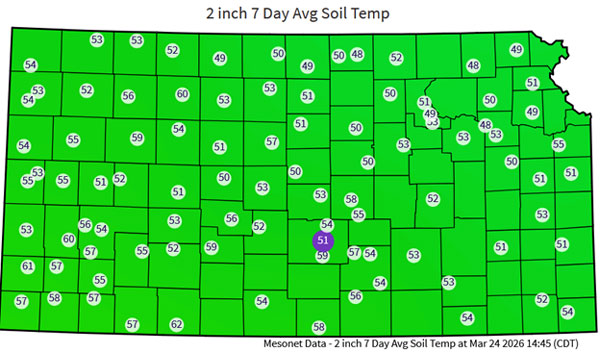
Figure 1. Average soil temperatures at 2-inch soil depth for the week of March 17 to 24, 2026. Source: Kansas Mesonet. (https://mesonet.k-state.edu/agriculture/soiltemp/)
Projections for the next 6-10 days lean toward above-normal temperatures statewide (Figure 2). In parallel, there is a slight favoring of above-normal precipitation across the entire region, which may help maintain cool soil temperatures (Figure 3). However, the probability of above normal precipitation isn’t overly high, just slightly more than normal/below normal chances for the period.
Topsoil temperature differences are field-dependent and are influenced by soil type, soil moisture, residue cover, tillage, landscape position, and many other factors. For example, wet soils under a no-tillage system are expected to warm up more slowly. Dry soils will fluctuate more rapidly, matching air temperatures, particularly if skies are clear.
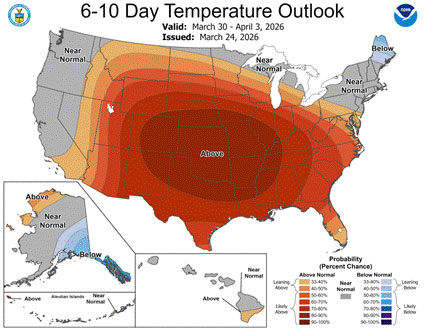
Figure 2. 6 to10-day temperature outlook for March 30 – April 3, 2026. Source: NOAA.
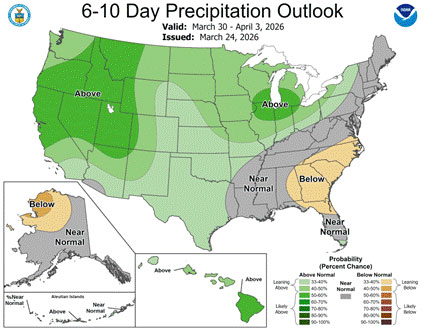
Figure 3. 6 to10-day precipitation outlook for March 30 – April 3,2026. Source: NOAA.
Soil moisture
Current soil moisture is lowest across portions of western Kansas (Figure 4), where some areas have gone three months without a wetting (0.1” in a day) rainfall. Precipitation earlier this month improved moisture in the eastern parts of the state. However, even those locations have observed a significant drying trend with recent hot/dry conditions.
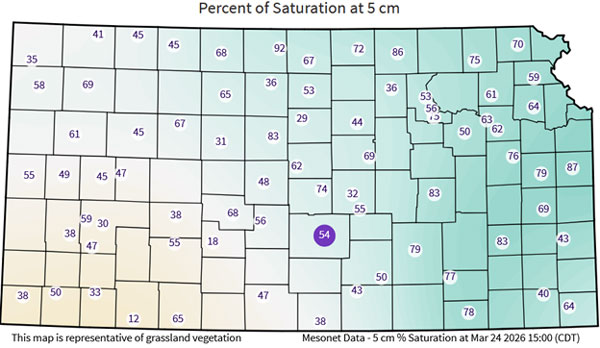
Figure 4. Soil moisture as percent of saturation at 2 inches (5 cm) as of March 24, 2026. Source: Kansas Mesonet https://mesonet.k-state.edu/agriculture/soilmoist/
Only a very small portion of the state along the Missouri border has observed above-normal precipitation over the last two weeks, with the remainder of the state measuring practically no moisture (Figure 5). No substantial change in moisture is expected in this region, and March is likely to be one of the driest on record without a drastic change in the forecast (Figure 3).
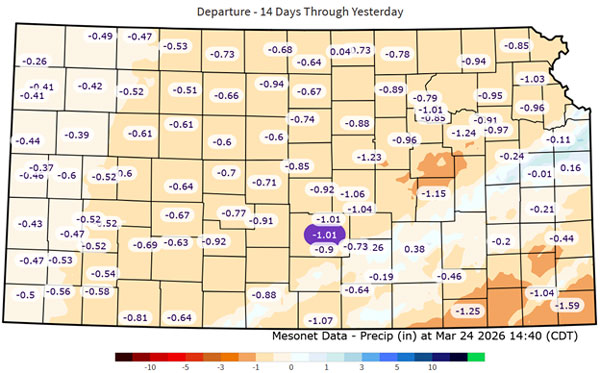
Figure 5. Departure from normal precipitation for the last two weeks ending March 24, 2026. Shades of orange indicate below normal precipitation. Source: Kansas Mesonet.
Management considerations
Optimal soil temperature for crop emergence
Corn and soybeans share a minimum germination and early growth temperature of 50°F. When soil temperatures remain at or below 50°F after planting, the damage to germinating seeds can be particularly severe. This is because the seed imbibes (absorbs) cold soil water within the first 24-48 hours after planting, causing damage to the cell membranes that assist in germination. This can result in seeds that are swollen, but do not germinate, or germination that stops after the radicle/coleoptile begins to emerge.
Uniformity and synchrony in emergence are critical and primarily achieved when soil temperatures are consistently above 55oF. Uneven soil temperatures around the seed zone can lead to non-uniform germination and emergence. Lack of uniform emergence can greatly impact corn yield potential due to inter-plant and weed competition and limited tillering capacity compared to other grains. Soybeans often overcome emergence issues due to their ability to branch
Impact of a hard freeze
Both corn and soybeans can be damaged by a hard freeze after emergence. The impact of a hard freeze on emerged corn and soybeans will vary depending on how low the temperature drops, the intensity and duration of the low temperatures, field variability, residue distribution, tillage system, soil type, moisture conditions (more severe under dry conditions), and the plant's growth stage.
Injury on corn is most likely to young seedlings or plants beyond the V5-6 growth stage when the growing point is above the soil surface.
For soybeans, the most susceptible stage is at emergence (cotyledons emerged) because the growing point is above the soil surface and more exposed to the cold temperatures. The most common sign of the impact of freezing temperatures on soybeans is damage to the stem and yellowing of the cotyledons.
The average day for the last spring freeze (32oF) varies considerably across the state (Figure 6). From southeast to northwest Kansas, the earliest last spring freeze date is April 1-14, and the latest is May 5-12. Thus, corn planting dates before the second week of April in the southeast or the second week of May in the northwest would pose a high risk of late-spring frost damage.
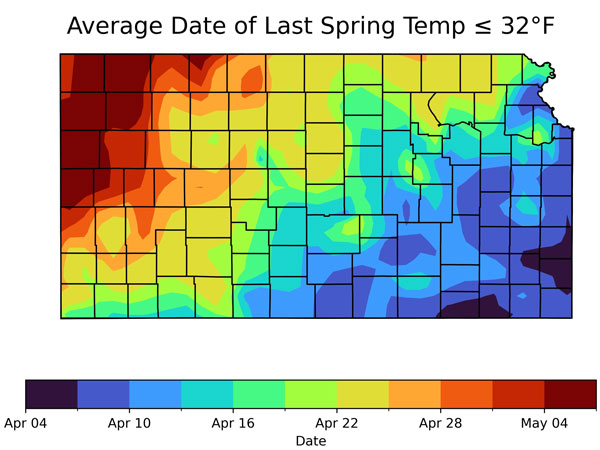
Figure 6. Average last spring freeze (32 degrees F) for Kansas. Source: Kansas Mesonet. Map created by Matthew Sittel.
More information about the planting status of summer row crops will be provided in upcoming issues of the Agronomy eUpdate. Stay tuned!
Tina Sullivan, Northeast Area Agronomist
tsullivan@ksu.edu
Logan Simon, Southwest Area Agronomist
lsimon@ksu.edu
Jeanne Falk Jones, Northwest Area Agronomist
jfalkjones@ksu.edu
Christopher “Chip” Redmond, Kansas Mesonet Network Manager
christopherredomond@ksu.edu
Tags: spring planting planting soil temperature soil moisture