Introduction
Site-specific weed management (SSWM) is the process of managing weeds only where they occur, instead of treating the entire field, including areas without weeds. This management system has been very helpful in reducing herbicide inputs and costs. Different technologies are commercially available to farmers for targeting weeds in both fallow settings and in-crop scenarios. Application systems using real-time weed detection can immediately turn on one or more spray nozzles to treat detected and/or identified weed plants. Platforms could have one or more spray booms with one or more tanks to allow for different herbicide mixtures that could include both broadcast and targeted applications.
This article discusses the basics of how these technologies work and how farmers can apply them in fallow systems. A second companion article will outline in-crop systems, recent K-State research, and herbicide cost savings.
Precision weed control in fallow settings
Targeted application systems that can detect/sense and spray emerged weeds on bare soil or fallow ground have been used for several decades. Optically-guided systems such as WEED-IT (Figure 1) and WeedSeeker® (Trimble Ag) work by detecting reflectance data from the ground. Such sprayers have detected weeds with a more than 95% positive rate.
Even newer technology uses machine vision, with cameras mounted on the boom that continuously take images of the fallow ground. Then the image data is transferred to the sprayer’s processing unit to detect ‘green’ weeds, and specific nozzles are activated to target-spray the weed (e.g., John Deere See & Spray™ Select). The number of nozzles activated can vary based on weed pressure within that area of the field (Figure 2). Based on the sprayer settings for detection sensitivity, the sprayer can switch between targeted spraying and broadcast spraying to ensure that weeds are not missed.
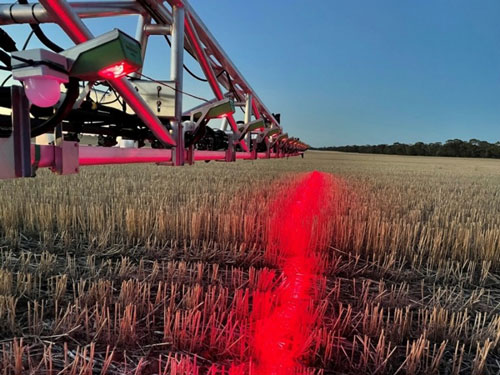
Figure 1. WEED-IT Quadro Red emits red LED lighting and detects returning chlorophyll fluorescence from plants. Image Courtesy Weed-IT (https://weed-it.com/what-is-weed-it/).
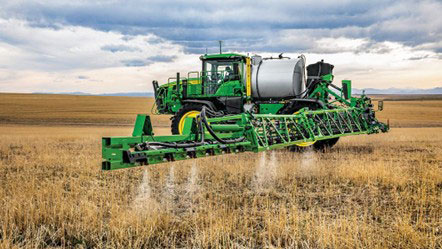
Figure 2. The number of nozzles activated by a weed detection system depends on weed pressure within that area of the field. Image courtesy of John Deere: https://www.deere.com/en/sprayers/see-spray.
How weed detection sensitivity works
The artificial intelligence algorithms that are used in the commercial sprayers (combining computer vision and machine learning) can be adjusted for their detection sensitivity, or how well they detect only weeds and not crop plants. Correctly identifying only a weed results in only spraying that weed (true positive), while incorrectly identifying a crop as a weed results in triggering the system to spray that crop plant (false positive). If weeds are present but not detected (false negative), the weed is not sprayed, and if there are no weed plants and the sprayer is not triggered to turn on, that would be a true negative. In this context, the false negatives are a concern because weeds remain untreated.
The benefit is that the threshold to classify a weed can be adjusted, ultimately affecting overall performance and resulting in more true positives. Thresholds are related to the size or area of the weed plant that can be detected. A small threshold represents high sensitivity and triggers more frequent spraying. A larger threshold reduces sensitivity, resulting in fewer applications and less herbicide use.
Sensitivity settings are used to determine the confidence of the algorithm in correctly detecting a weed, with lower thresholds increasing the probability of detecting more weeds and higher thresholds likely resulting in missed weed detections. In terms of precision spraying, these confidence intervals can translate to an efficacy (lower) threshold with more herbicide applied or a savings (higher) threshold approach resulting in less herbicide being applied. A fallback mode enables the machine to transition between targeted applications and broadcast applications whenever the boom encounters issues, including high weed pressure (i.e., a large area of green detected by the camera).
Application accuracy and sprayer settings
If booms and travel speeds are both low, an individual detected weed can be targeted accurately with relatively short band lengths because relatively little can happen to displace the spray during its short journey. However, as boom and travel speeds increase, predicting the time it takes for the spray to arrive at the target becomes more challenging, and longer band lengths need to be programmed. For example, wind can push the spray off its target. Or the faster speeds impart more of a horizontal vector to the spray, causing it to land further away from the point of release. Wind, droplet size, spray velocity, and boom height all influence where the spray ultimately lands.
This article establishes how targeted spraying works in fallow fields and introduces the concepts behind detection sensitivity and spray accuracy. The next article will focus on in-crop systems and the economic benefits of targeted spraying.
Jeremie Kouame, Weed Scientist – Agricultural Research Center, Hays
jkouame@ksu.edu
Anita Dille, Professor – Weed Ecology
dieleman@ksu.edu
Tags: herbicides weed management precision agriculture targeted spraying fallow