Days with low humidities and exceedingly high winds have combined with abundant dry fuels from last year’s good grass production to once again result in wildfires throughout Kansas (Figure 1). Several fires occurred last week in southwestern Kansas, including the Ranger Road Fire, which overlapped areas burned in the 2017 Starbuck Fire, which affected approximately 660,000 acres in Kansas (Figure 2).
Grassland vegetation is highly adapted to fire, and fire should not permanently harm the quality of vegetation on native rangelands. However, a wildfire may act differently from a carefully planned prescribed burn. If the fire produces enough heat, it could cause some damage, especially to bunch grasses, potentially resulting in a decline in productivity for a year or two. The best general advice for now on burned rangeland is to just wait and see how well it recovers.
A companion article in this eUpdate discusses management on cropland, soil quality, and soil erodibility.
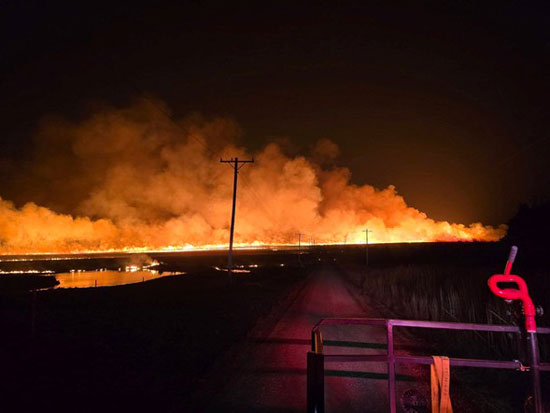
Figure 1. Photo of a 4,000-acre fire that burned in Chautauqua and Elk counties in early February. Courtesy of the Elk County Rural Fire Department.
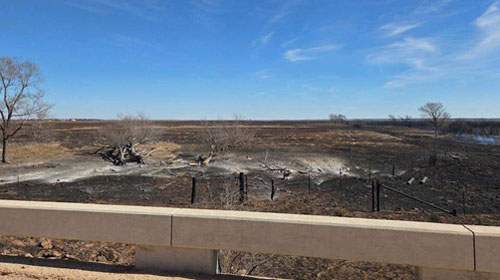
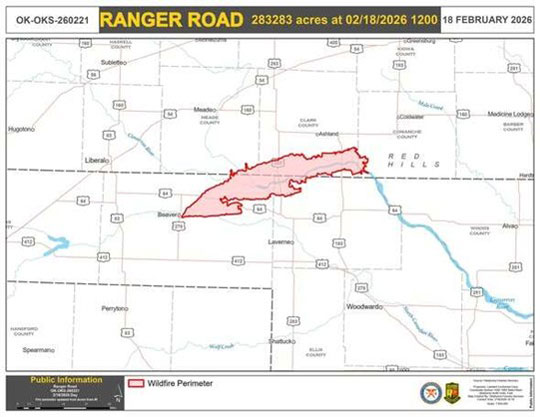
Figure 2. Aftermath of the Ranger Road Fire in Clark County (top) and the fire perimeter extending from Oklahoma into Kansas (bottom). The fire is contained as of this publication and burned approximately 280,000 acres. Images courtesy of Dr. Randall Spare (top) and the Oklahoma Forest Service (bottom).
Effects on Rangeland and Management Strategies
Where a wildfire occurs, the ability of rangeland or tamegrass pastures to regenerate forage depends on precipitation amounts, the time of year the fire occurs, the water infiltration ability of the soil, and management factors following the fire. Most of the soils in western Kansas were in a drying phase at this point in the winter. The topsoil was generally quite dry at the time of the fire, and while the subsoil was moist early in the winter, subsoil was also drying at this point. Dry soil will slow grass recovery and may take up to a few years to fully recover, depending on moisture during the growing season.
Research Summary: Post-fire Forage Response
- Shortgrass rangeland (blue grama, buffalograss, western wheatgrass) burned mid-March in a dry year: 65% production reduction year 1, 39% reduction year 2.
- December wildfire in shortgrass: ~25% reduction year 1; ~10% lower production sustained after 3 years.
- Mixed prairie (post–Four County Fire, Dec 2021): little bluestem cover declined and 25% first-year forage reduction. Recovery occurred as big bluestem and sideoats grama (both rhizomatous) increased. No reductions in years 2–3.
Expect first-year reductions that vary by vegetation type and moisture, with typical recovery by year 2–3 when precipitation is adequate.
Fire Behavior and Plant/Soil Impacts
Wildfires tend to move rapidly, typically driven by high winds, low relative humidity, and warm air temperatures. Movement through rangeland grasses, especially those with rhizomes, is normally quick with reduced residence time. Therefore, it is expected that grasses will recover in time. Wildfires can also reduce stored carbohydrate reserves for grass plants, reduce moisture infiltration, increase evaporation and runoff, lead to erosion, create grazing distribution problems, and possibly lead to an increase in weedy species.
The crowns of grass plants often survive a wildfire and will regrow, but some can be damaged if the fire occurs when soil and air conditions are extremely dry. Bunchgrasses, such as little bluestem, are the grasses most likely to experience any injury because of litter and old vegetation buildup at the base of the plant as fuel. If plant litter remains after the fire, less damage will have occurred to the plant crowns, and soil conditions will be better. Evaporation and runoff are likely to increase, especially if the fire occurs early in the dormant season. Bare soil may lose at least one-half inch of moisture per week through evaporation. The higher the clay content of the soil, the greater the potential for puddling and runoff.
Trees can burn quite hot and for an extended period of time if they catch fire. Eastern red cedar trees, among others, may be killed by a wildfire. On rangeland, this would normally be considered a good thing. Smoldering trees can continue to throw off burning embers until the fire is completely out; use caution that these smoldering trees can reignite a fire in the area.
Good precipitation during the early growing season following the wildfire will hasten recovery and lessen the immediate impact of the fire.
Native Warm-Season Grass Rangeland
Between mid-March and June, wildfires generally do not reduce forage production as much as fires later in the year. However, if conditions are dry, regrowth will not occur, and the stocking rate must be reduced. Wildfires at this time may change the plant composition of the grazing land.
When wildfires occur between late June and frost, the primary concern is protecting plants from overuse. Immediate removal of the grazing animals is usually necessary. This will permit regrowth and allow plants to accumulate food reserves before winter.
Wildfires occurring between fall and mid-March leave the soil bare until spring growth. Forage yields will be reduced, and a reduction in stocking rate is advised.
On sandy soils, blowouts (eroded areas) should be controlled as soon as possible. Mulching with manure, straw, or hay free of noxious weeds, along with reseeding can stabilize the blowout area. Fencing of blowouts will restrict livestock traffic and speed recovery. Much of the region in the Ranger Road Fire is sandy soils, and the large amount of acreage burned, combined with strong winds, has resulted in sandy native rangeland soil blowing and drifting within days. Please refer to the companion article in this eUpdate to learn more about wind erosion management options after a wildfire.
Grazing Management Options After Wildfire
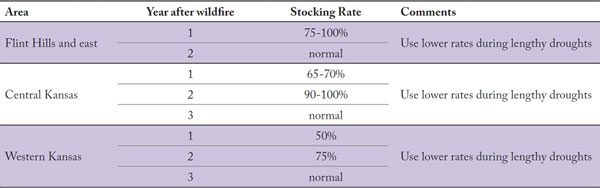
For forage plants to recover, it will usually be necessary to reduce stocking rates on the burned area (Table 1). The main concern is the plants' inability to regrow. The plants must be given the opportunity for regrowth during drought. In fact, the drought during the 2022 growing season following the Four County Fire reduced average forage production more than the effects of the fire itself, so balancing expected forage production with animal demand is important to maintain plant vigor.
Table 1. Stocking rate guidelines for pastures burned by wildfire occurring any time other than late spring, from K-State Extension Publication “Rangeland Management Following Wildfire” (L514).
If a wildfire occurs where prescribed burning is generally practiced, burn the areas that were untouched by the wildfire in late spring, when the desirable grass species have 1 to 1.5 inches of new growth. This will encourage grazing of the entire pasture. Observe where the animals are grazing and use grazing distribution tools, such as salt, mineral, and oilers, to attract cattle to underutilized areas.
If a wildfire occurs where prescribed burning is not practiced, management decisions should be based on when the grassland was burned, how much of it was burned, and where livestock water is located. Below are some example scenarios paired with management options.
Example 1: If there is a livestock-watering source in both the burned and unburned portions of the grassland, divide the burned and unburned areas (using an electric fence, for example) and reduce the stocking rate in the burned area.
Example 2: If there is only one livestock-watering source in the grassland area, the decision is whether to manage the burned or the unburned area.
- If the unburned area is larger, separate the two areas with an electric fence and stock the unburned area at the normal rate.
- If the burned area is larger, either manage only the burned part by reducing the stocking rate or establish an alternate water source, fence the area, and reduce the stocking rate on the burned portion.
- If the sole watering source is in the burned portion, the unburned portion would not be utilized unless the area was fenced and another water source established, or a lane is fenced off to allow watering from the unburned area.
Example 3: If only a small portion of the grassland is burned, fence it off and reduce the stocking rate on the unburned portion accordingly.
Example 4: In areas where prescribed burning is commonly practiced, a partial burn of one-third of the pasture may provide an opportunity to try patch-burn grazing. Livestock will concentrate on the recently burned area, but the next year, a different third of the pasture will be burned, and the livestock will change their grazing habits. Patch-burn grazing will result in rotational grazing without using a fence.
Mowing unburned areas in the early spring can encourage livestock to move from the burned area. However, don’t mow in August or September. Early intensive grazing is another option for burned areas. Removing all livestock from the grassland by mid-July provides late-season rest and time for the desirable grasses to replenish root reserves.
Tamegrass Hay Meadows
Hay meadows burned by wildfires will likely produce less hay as this grass type does not positively react to burning, especially as we move out of February. To return hay meadows to their former production, cut the meadow in early to mid-July to allow regrowth and replenishment of root reserves. Be cautious about late cutting of cool-season tamegrass (e.g., smooth bromegrass), as it may leave it more susceptible to fall armyworm damage.
For more information, see:
Rangeland Management Following Wildfire, K-State Research and Extension publication L-514 at: https://bookstore.ksre.ksu.edu/Item.aspx?catId=364&pubId=385
Molly Reichenborn, Rangeland Management Specialist
mreichenborn@ksu.edu
Keith Harmoney, Range Scientist
kharmone@ksu.edu
John Holman, Southwest Research-Extension Center Agronomist
jholman@ksu.edu
Tina Sullivan, Northeast Area Agronomist
tsullivan@ksu.edu
Lucas Haag, Agronomist-In-Charge, Tribune
lhaag@ksu.edu
Jeanne Falk Jones, Northwest Area Agronomist
jfalkjones@ksu.edu
Chip Redmond, Kansas Mesonet Manager
chrisopherredmond@ksu.edu