Now is the time to finalize plans for kochia control. In western Kansas, kochia is among the first summer annual weeds to emerge in the spring. Recent research suggests that kochia can begin emerging in early February, with most kochia emerging by late April. Kochia seedlings have been observed as early as February 7 in southwest Kansas.
Good control of the first dense flush of kochia is essential for obtaining a good crop yield. Early-emerging seedlings use the limited spring soil moisture in dryland production fields. Kochia seedlings emerge in dense populations, making adequate herbicide coverage difficult (Figure 1). In addition, glyphosate-resistant kochia is prevalent across western Kansas, making kochia control even more challenging. For these reasons, it is important to apply preemergence herbicides in late winter or early spring to control kochia before it emerges. This article will be the first in a series discussing specific options for various cropping scenarios.
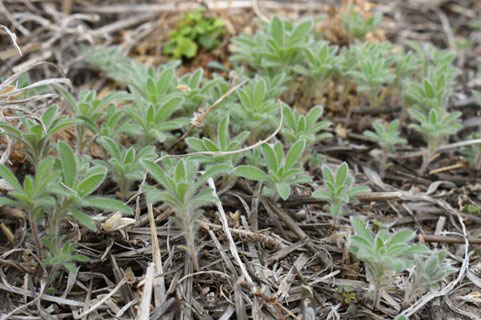
Figure 1. Emerged kochia seedlings in a fallow field. Photo by Sarah Lancaster, K-State Extension.
Herbicide program components to effectively manage kochia at germination
To successfully manage kochia, an herbicide program needs two components:
- a very soluble and effective herbicide that can be incorporated with very little precipitation, such as dicamba; and
- an herbicide that has longer residual activity, which will require perhaps 0.75 inches or more precipitation for adequate incorporation, such as atrazine.
Precipitation events during late winter are often too small to activate longer-lasting residual herbicides, but dicamba may control kochia for 4 to 6 weeks until atrazine is incorporated.
The best time to apply herbicides for kochia control is prior to kochia emergence, generally January through the first week of March, but this depends on weather conditions. Later applications, for example, at the time of burndown, are more likely to occur after kochia emergence, which increases the risk of control failure (Figure 2). Fall-applied treatments can help ensure timely application; however, they are not likely to control later flushes of kochia effectively (Figure 3).
Other herbicides with good preemergence kochia activity include: mesotrione (Callisto, others), metribuzin (Sencor, others), saflufenacil (Sharpen), sulfentrazone (Spartan, others). Be sure to check product labels for crop-specific planting intervals. For example, sulfentrazone requires a 10 to 18-month rotation interval to corn.
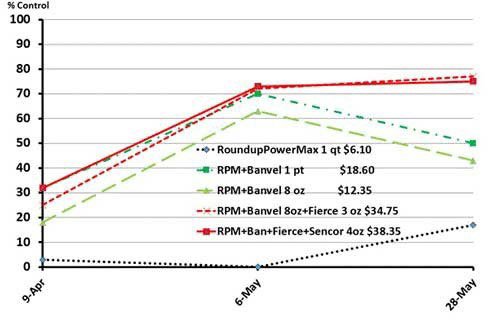
Figure 2. EPP/POST herbicides applied March 10, 2015 for kochia control at Tribune, KS. Kochia at cotyledon stage. Graph by C. Thompson, K-State Extension.
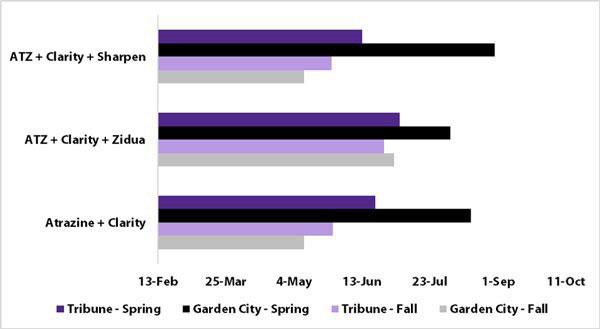
Figure 3. Duration of anticipated kochia control greater than 80% following fall (December 4) and spring (February 23) herbicide applications at two locations during 2015. Data from Vipan Kumar, K-State Extension.
The use of trade names is for clarity to readers and does not imply endorsement of a particular product, nor does exclusion imply non-approval. Always consult the herbicide label for the most current use requirements.
For more information on controlling kochia, see the 2026 Chemical Weed Control for Field Crops, Pastures, Rangeland, and Noncropland, K-State publication SRP1194.
Sarah Lancaster, Weed Management Specialist
slancaster@ksu.edu
Jeremie Kouame, Weed Scientist – Agricultural Research Center, Hays
jkouame@ksu.edu
Patrick Geier, Weed Scientist – Southwest Research & Extension Center, Garden City
pgeier@ksu.edu