Trends of rising fertilizer and other input costs over the past decade have been exacerbated by current conflicts, which are impacting global supply chains and increasing prices for farmers. This development requires integrated fertilizer management to improve nutrient use efficiency and reduce costs. Sorghum is very efficient in using nutrients from the soil due to its extensive fibrous root system. Typically, nitrogen (N) is the nutrient most frequently lacking in soil. Nitrogen recommendations vary based on expected yield, soil texture, cropping sequence, and environment.
Residual N in the soil profile
Residual nitrogen in the soil profile can be an important nutrient source for grain sorghum. This is particularly important due to recent drought conditions that reduced yields or led to crop failure in Kansas. Nitrogen not used by the previous crop can remain in the soil profile, particularly in dryland environments, and will be available for sorghum in the next crop rotation. K-State guidelines recommend taking soil samples at a depth of 24 inches to assess the amount of profile N through soil testing and adjust the fertilizer N rate accordingly.
The current K-State N recommendation guidelines include efficiency factor adjustments based on crop and fertilizer management (https://bookstore.ksre.ksu.edu/pubs/MF2586.pdf). Adjust the N requirement by 20 pounds of available N per acre for each 1.0% soil organic matter measured on the surface 6 inches. Fertilizer management practices affecting the crop’s N use efficiency include fertilizer placement, timing, rate, and source.
Fertilizer placement
Nitrogen recovery efficiency is affected by fertilizer application methods. For example, injecting urea-containing fertilizers below the surface in no-till or reduced tillage systems can minimize ammonia volatilization and N immobilization losses. However, when urea or urea-containing fertilizer is surface-applied and not incorporated, or when it does not receive more than 0.25 inch of rainfall or irrigation following application, significant ammonia loss might occur, reducing fertilizer efficiency. If desired, the application of urease inhibitor products can prevent volatilization losses for 14-21 days when the fertilizer is surface-applied in no-till or high-residue systems. These products can be viewed as an insurance policy to prevent volatilization until an incorporating rainfall (exceeding 0.40”) or irrigation event occurs.
In general, there are minimal agronomic differences among N sources when properly applied. A recent K-State study in Hays found that subsurface application of 60 lb/acre urea produced grain sorghum yields comparable to broadcast applications of about 85 lb N/acre (Figure 1). In that same study, grain yields with subsurface urea application were similar to broadcast ESN, Super U, or urea plus NBPT (urease inhibitor). This particular example showed a 25 lb N/acre savings compared to broadcast application when N losses are minimized (Figure 1)
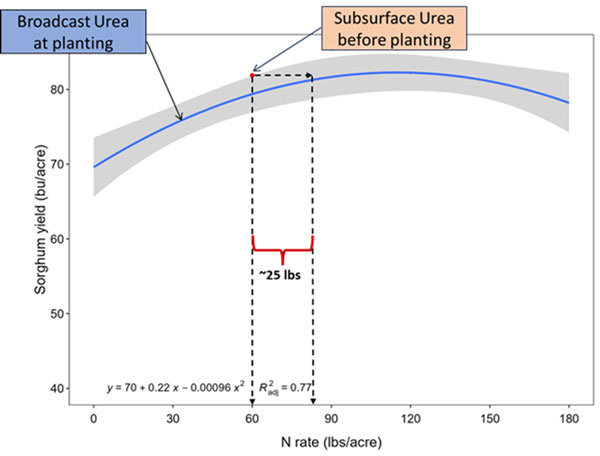
Figure 1. Grain sorghum response to broadcast versus subsurface urea application in 2021 at Hays, KS. Graph by Dorivar Ruiz Diaz, K-State Extension.
Fertilizer application timing
Time fertilizer application so N is available when needed for the rapid growth stages between the five-leaf and boot stages. Preplant N applications in late fall or early spring will have little leaching loss in dryland systems except on sandy soils. On sandy soil, delay preplant N applications until late spring; sidedress or split N applications to improve recovery efficiency (spring and sidedressed). Make sidedress N applications no later than the five-leaf stage.
Assessing soil water storage at planting
In dryland environments, sorghum response to fertilizer N is dependent on a combination of soil water at planting and in-season precipitation. In dryland, measuring the depth of moist soil could provide a measure of water stored at crop planting. Results of a 32-year study in Hays, KS, showed that the depth of moist soil determined at planting with a Paul Brown probe could be used to fine-tune N application rates for sorghum. In this study, grain yield increased by 3.9 to 8.2 bu/acre per inch of available soil water at planting for the unfertilized control and the 60 lb N/a rate (Figure 2).
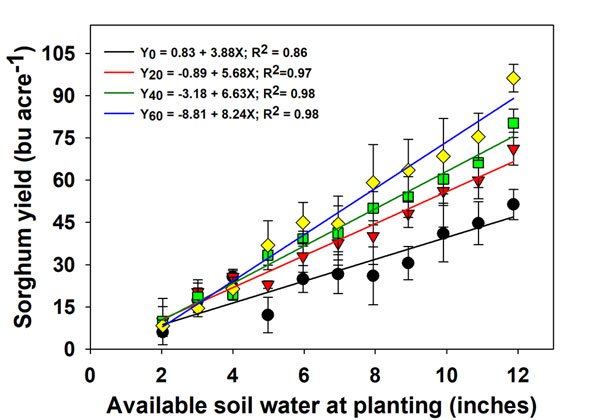
Figure 2. Relationship between available soil water and grain sorghum yield at four fertilizer nitrogen rates averaged from 1972 to 2002 in Hays, KS (0, 20, 40, and 60 lbs N/acre). Graph by Augustine Obour, K-State Research and Extension.
Take-Home Message
- Residual N can significantly contribute to sorghum nutrition, particularly in dryland systems.
- Nitrogen recommendations should be adjusted based on soil organic matter, profile N, and environmental conditions.
- Surface-applied urea is prone to volatilization losses without timely rainfall or incorporation.
- Subsurface placement and use of urease inhibitors can improve N recovery efficiency.
- Available soil moisture at planting plays a critical role in sorghum response to applied N.
Augustine Obour, Soil Scientist
aobour@ksu.edu
Dorivar Ruiz Diaz, Nutrient Management Specialist
ruizdiaz@ksu.edu
Lucas Haag, Northwest Area Agronomist
lhaag@ksu.edu
Peter Tomlinson, Environmental Quality Specialist
ptomlin@ksu.edu