Soil and plant tissue tests can provide critical information for growers, but interpreting the results can be daunting. Several digital tools are available from K-State for free to assist with this process. These tools help growers apply published nutrient guidelines while reducing the risk of calculation errors. They are available as both web-based applications and spreadsheet programs, providing flexibility across different devices and work environments.
These tools can be accessed or downloaded from the soil testing lab’s webpage:
https://www.agronomy.k-state.edu/outreach-and-services/soil-testing-lab/recommendations.html
Web-based Fertilizer Recommendation Tool
The Fertilizer Recommendation Tool is a web-based application designed to apply the fertilizer recommendation procedures described in Soil Test Interpretations and Fertilizer Recommendations in Kansas (MF2586). The tool is organized into modules (tabs) for each nutrient and includes a general user guide (Figure 1). This lightweight application is particularly useful for quick “on-the-go” calculations, as it is mobile-friendly and does not require a download.
Access the tool at https://ksusoiltesting.shinyapps.io/FertRecKS_App-R-v2/
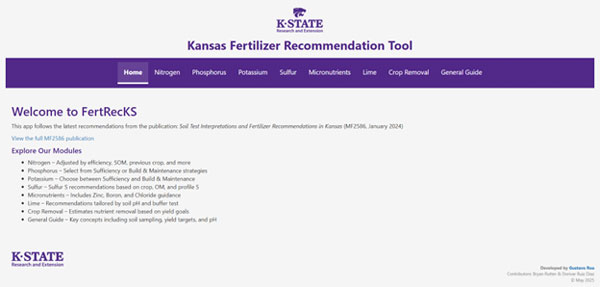
Figure 1. Screenshot of the Kansas Fertilizer Recommendation Tool home screen and layout.
How it works
Users specify crop information, expected yield, soil test values, and relevant management practices. The tool then applies the equations and logic described in MF-2586 to generate recommended fertilizer application rates. Automating calculations helps reduce errors and missed steps that can arise when recommendations are calculated manually. The calculator includes modules for nitrogen, phosphorus, potassium, sulfur, selected micronutrients (chloride, boron, and zinc), lime, and crop nutrient removal, along with a general user guide. Each module functions independently, allowing users to focus on specific nutrients as needed.
Spreadsheet-based Fertilizer Recommendation
An Excel-based program is also available to support the calculation of fertility prescriptions (Figure 2). Designed for those with access to a laptop or desktop computer, it provides recommendations for multiple nutrients simultaneously in a familiar spreadsheet format. The tool is particularly useful for growers with detailed soil test results from multiple samples or with different crops associated with each sample.
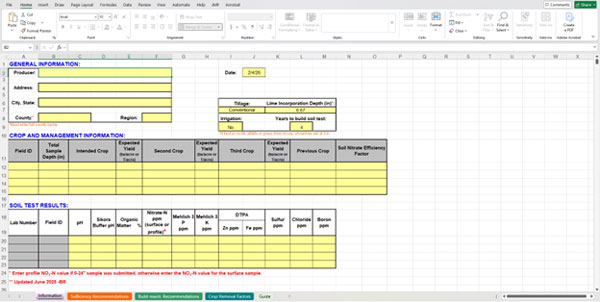
Figure 2. Screenshot of the Excel-based fertilizer recommendation program showing organization of field information, soil test results, and management inputs.
How to access the tool
The calculator is available for download through a link on the soil testing lab’s webpage:
How it works
Similar to the web application, users enter general field information, crop and management details, and results from their soil test report. The workbook then generates fertility recommendations based on both “sufficiency” and “build/maintain” approaches in accordance with the MF-2586 fact sheet.
Plant Tissue Test Interpretation Tool
The Plant Tissue Test Interpretation Tool is a web-based tool that provides a visual aid for interpreting plant tissue test results. The tool creates a graph showing sufficiency ranges of multiple nutrients based on the crop type, maturity, and plant part (Figure 3). It can also serve as a reference for determining which growth stages and plant parts should be sampled when comparisons to published ranges are needed.
Access the tool at https://ksusoiltesting.shinyapps.io/PlantTissueApp/
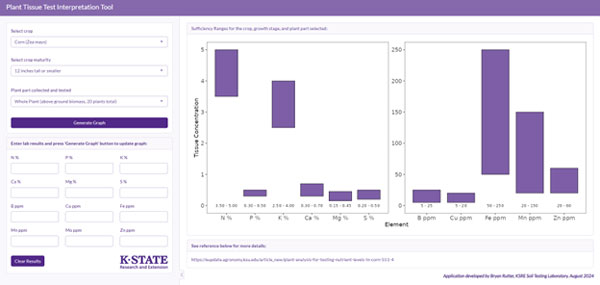
Figure 3. Example output from the Plant Tissue Test Interpretation Tool for corn tissue tests at the V6 growth stage.
How the calculator works
Users specify the crop type, growth stage, and part of the plant that was or will be tested by the lab. The tool then generates a graph illustrating the sufficiency ranges for several nutrients. Users may also enter their own lab results to create a visual comparison of their tissue analysis against the sufficiency ranges.
Supporting Materials and Development
These tools are intended to be used alongside existing fertilizer recommendation publications and soil testing resources to help users apply nutrient guidelines consistently. Additional references, guidance documents, and tools are available through the soil testing lab’s webpage at:
https://www.agronomy.k-state.edu/outreach-and-services/soil-testing-lab/recommendations.html
Future efforts are focused on improving usability, consistency, and integration across tools. User comments and suggestions are welcome and will help guide future refinements.
Gustavo Roa, Graduate Research Assistant
groa@ksu.edu
Bryan Rutter, K-State Soil Testing Lab Manager
rutter@ksu.edu; soiltesting@ksu.edu
Dorivar Ruiz Diaz, Nutrient Management Specialist
ruizdiaz@ksu.edu
Tags: soil testing tissue testing soil fertility fertilizer recommendations