Postemergence weed control in sorghum, especially grass weeds, has always been limited compared to many of our commonly grown crops. Although sorghum is a major crop in Kansas, the acreage planted nationwide is considerably less than for corn, soybeans, or wheat (Figure 1). Consequently, herbicides used in sorghum must often be registered in other crops in order to be economically practical for chemical companies. However, herbicide-resistant sorghum hybrids have been developed to help producers manage weeds. This article discusses the three herbicide-resistant sorghum technologies available in Kansas in 2026.
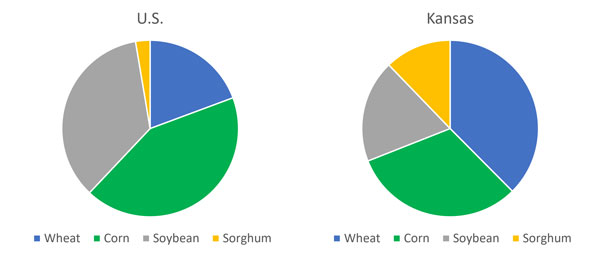
Figure 1. Proportions of the four largest crops planted in the U. S. and Kansas in 2025. Graphs based on acreage reported to the Farm Service Agency.
Inzen grain sorghum and Zest herbicide
Grain sorghum containing the Inzen tolerance trait may be sprayed postemergence with Zest (nicosulfuron) herbicide. Pioneer has two hybrids available for Kansas in 2026: 85Z65 (70 RM, red grain, suited for high-yield environments) and P88Z153 (61 RM, red grain, suited for a range of yield environments).
Zest, a Group 2 herbicide in the sulfonylurea family, inhibits the ALS enzyme. Due to the widespread use of Group 2 herbicides in the past, several problematic weeds have developed resistance to this herbicide group. In Kansas, these include kochia, Palmer amaranth, common sunflower, and waterhemp. Zest has limited activity against broadleaf weed species but provides good to excellent control of foxtails, barnyardgrass, fall panicum, and witchgrass.
- Apply Zest when sorghum is 4 to 20 inches tall, but before weeds reach the maximum height listed on the label. Application rate is 0.67 to 1.33 oz/a, and may be applied twice per year, provided the total amount of product does not exceed 1.8 oz.
- Always include nonionic surfactant (NIS) at 0.25 to 0.5% v/v or crop oil concentrate (COC) at 1.0 to 2.0% v/v. Use the higher rates of these surfactants when applying in dry conditions.
- A nitrogen source [ammonium sulfate (AMS) or urea-ammonium nitrate (UAN)] at 2 lb/a or 2 qt/a will also enhance efficacy with Zest. Do NOT apply in 100% UAN carrier.
- Do NOT mix Zest with Huskie (pyrasulfotole + bromoxynil) herbicide or use COC when mixing Zest with 2,4-D or dicamba.
A complete list of stewardship practices for Inzen grain sorghum can be found at https://www.corteva.com/trait-stewardship.html
Igrowth sorghum and ImiFlex herbicide
Igrowth sorghum (both grain and forage hybrids) may be sprayed with ImiFlex (imazamox) herbicide. For 2026, Alta Seed has three hybrids: ADV G1141IG (early-maturing, recommended for Western High Plains and double-cropping after wheat), ADV G1125IG (medium-early, red grain, adapted to all of the High Plains), and ADV G2168IG (medium-maturity, red grain, good for dryland fields).
Like Zest, ImiFlex is an ALS-inhibiting herbicide, though it belongs to the imidazolinone family. However, resistant weed species will not be controlled with ImiFlex. ImiFlex may be applied preemergence at 6 to 9 oz/a or postemergence at 6 oz/a up to 20-inch tall sorghum. Only one application per year is allowed. Preemergence applications to grain sorghum should include other residual herbicides, including atrazine, mesotrione (Callisto, others), and Group 15 herbicides like S-metolachlor (Dual II Magnum, others) or dimethenamid (Outlook). Sorghum seed must be used when Group 15 herbicides are applied. Currently, only atrazine and S-metolachlor/metolachlor are labeled for use on forage sorghum.
Postemergence weeds must be 3 inches or less in height for ImiFlex to be effective, except for non-imidazolinone-resistant volunteer corn, which may be controlled up to 8 inches in height. Figure 2 shows the importance of applying to small weeds. Green foxtail was 4 to 6 inches at the time of application, whereas crabgrass was 1 to 2 inches in height. Foxtail suppression was less than 80% regardless of the herbicide applied. Conversely, all herbicides provided greater than 90% crabgrass control.
- Include COC or methylated seed oil (MSO) at 1 to 2% v/v along with a nitrogen source (5% UAN or 20 lb/100 gallons AMS) when applying ImiFlex postemergence.
- When applying in a tank-mixture with 2,4-D or dicamba, substitute NIS at 0.25% v/v in place of COC or MSO to minimize the risk of crop injury.
- Do NOT mix ImiFlex with Huskie, Peak, or Ally herbicides as unacceptable crop injury can occur.
For complete stewardship information, contact your local Igrowth seed dealer.
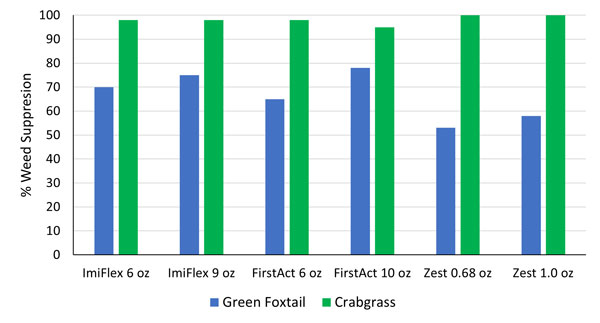
Figure 2. Weed control of large foxtail (4 to 6 inches) compared to small crabgrass (1 to 2 inches) at 29 days after postemergence applications. The study was conducted in 2001 at Garden City. Graph created by Patrick Geier, Kansas State University.
Double Team sorghum and FirstAct herbicide
Double Team sorghum (both grain and forage hybrids) allows the postemergence application of FirstAct (quizalofop) herbicide. FirstAct is a Group 1 (ACCase-inhibiting) herbicide.
Some key DoubleTeam hybrids that are available in 2026 include:
- SP 30A30 DT is an early-maturing hybrid with bronze seed suitable for double-cropping
- SP 45A45 DT is a medium-early hybrid with Bronze seed that can be placed on dryland or irrigated acres
- SP 58M85 DT is a medium-maturity hybrid with bronze seed that tolerates cool soils well
- SP 65B21 DT is a medium-maturity hybrid adapted to dryland and irrigated conditions.
Herbicides in Group 1 only control grasses and provide no residual control. FirstAct provides excellent control of many of our common grasses, including glyphosate-, glufosinate-, and imidazolinone-tolerant volunteer corn. However, volunteer corn containing the Enlist herbicide tolerance trait will not be controlled by FirstAct. It is important to note that grass activity with FirstAct can be antagonized by the addition of broadleaf tank-mix partners, especially Group 4 herbicides such as dicamba, fluroxypyr (Starane), and 2,4-D.
Broadleaf herbicide applications should be made 1 day before or 7 days after FirstAct application. Double Team hybrids are designated either as “DT” or “DT2”. For DT hybrids, sorghum must be 11 inches or taller before FirstAct is applied, but in DT2 hybrids, applications can be made once sorghum reaches 4 inches tall. This is because DT hybrids contain a single copy of the resistance gene (only one parental line carries the trait), whereas DT2 have two copies of the resistance gene (both parents carry the trait). FirstAct should be applied before sorghum reaches 20 inches tall for both DT and DT2 hybrids. FirstAct may be applied at 5 to 12 oz/a depending on the weeds to be controlled. COC is the preferred adjuvant with FirstAct, and UAN (2 to 4 qt/a) or AMS (2 to 4 lb/a) may be included. Sequential applications are permitted as long as the total product amount does not exceed 21 oz per year.
Full stewardship requirements can be found at sorghumpartners.com/double-team/
Important considerations with herbicide-resistant sorghum
Properly managing herbicide-tolerant sorghum is important for preserving the technology in the future. Cultural and mechanical weed management practices are necessary for successful sorghum production. Controlling any existing weeds prior to planting and applying a strong preemergence herbicide at planting are critical for managing weeds in sorghum. No herbicide-tolerant sorghum is currently labeled for control of shattercane (Sorghum bicolor) or johnsongrass (Sorghum halapense). Both of these species readily cross-pollinate with our cultivated sorghum varieties, and the likelihood of resistance being passed to these weeds is high. Shattercane resistance to ALS-inhibiting herbicides was first identified in Kansas in 1996. Steps must be taken to ensure shattercane and johnsongrass in or near fields planted to herbicide-tolerant sorghum do not flower at the same time as the crop.
Specific stewardship guidelines are available from retailers marketing the sorghum and herbicides mentioned in this article. The United Sorghum Checkoff Program provides an excellent pamphlet of general stewardship guidelines at: https://www.sorghumcheckoff.com/wp-content/uploads/2022/12/09_2022_HT_StewardshipGuide.pdf
More information on sorghum weed control can be found in the 2026 K-State Chemical Weed Control Guide SRP-1194.
The use of trade names is for clarity to readers and does not imply endorsement of a particular product, nor does exclusion imply non-approval. Always consult the herbicide label for the most current use requirements.
Patrick Geier, Weed Scientist - Southwest Research & Extension Center, Garden City
pgeier@ksu.edu
Sarah Ganske, Weed Science Extension Specialist
slancaster@ksu.edu
Jeremie Kouame, Weed Scientist – Agricultural Research Center, Hays
jkouame@ksu.edu
Tags: sorghum weed control post-emergence hybrids herbicide-tolerant