Herbicide safeners are included in many herbicides and seed treatments to prevent crop injury. However, there are not many resources that explain how safeners work and when they are used. This article will discuss how safeners work and which herbicides and crops they benefit.
What are safeners?
Safeners were developed in the 1970s to protect corn from S-metolachlor injury. Safeners have been developed for seed treatments, pre- and post-emergence applications, and can also be applied to standing water in rice fields. Seed-treatments and pre-emergence options are most common, especially for corn and sorghum. Safeners are often co-formulated with herbicides for pre- and post-emergence applications. A wide variety of safeners are available for grasscrops, but very few have been developed for broadleaf crops. Common commercialized safeners are presented in Table 1.
How do safeners work?
Safeners protect specific crop species by enhancing the crop’s ability to detoxify specific herbicides. Protection occurs when a safener increases the expression of genes that produce enzymes that metabolize herbicides and other chemicals in the crop. These enzymes include cytochrome P450 monooxygenases (CYP450s ), glutathione S-transferases (GSTs), UDP-glucosyltransferases (UGTs), and ATP-binding cassette transporters (ABD transporters). However, safeners are species-specific, so the enzymes in weeds are unlikely to be affected by the safeners.
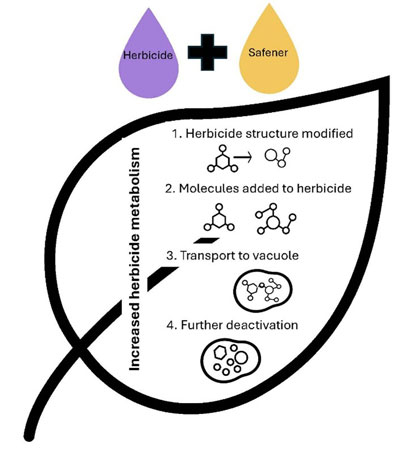
Figure 1. When safeners are used with herbicides, they increase herbicide metabolism to reduce crop injury. Graphic created by Yasir Parrey, Kansas State University.
Table 1. Application timing and associated herbicides of some commercialized safeners used in Kansas crops (adapted from Rosinger, 2014).
|
Safener |
Application timing |
Active ingredient (Herbicide group) |
Example products |
Crop |
|
Benoxacor |
Pre- and Post-emergence |
S-metolachlor (15) |
Dual II Magnum, Acuron, Lexar, Lumax, Resicore Rev |
corn |
|
Cloquintocet |
Post-emergence |
pinoxaden (1), quizalofop (1), flucarbazone (2), pyroxsulam (2), bicyclopyrone (27) |
Aggressor, Axial, Everest 3.0, PowerFlex HL, Quelex, Talinor |
wheat, other cereals |
|
Cyprosulfamide |
Pre- and Post-emergence |
Thiencarbazone (2), dicamba (4), isoxaflutole (27), |
Balance Flexx, Corvus, DiFlexx, TriVolt |
corn |
|
Dichlormid |
Pre-emergence |
acetochlor (15) |
Surpass |
corn |
|
Fluxofenim |
Seed treatment |
S-metolachlor (15) |
Dual II Magnum |
sorghum |
|
Furilazole |
Pre-emergence |
acetochlor (15) |
Harness®, SureStart II, TripleFLEXII, Resicore |
corn |
|
Isoxadifen |
Post-emergence |
nicosulfuron (2), rimsulfuron (2), dicamba (4), tembotrione (27) |
Accent Q, Capreno, Laudis, Revulin Q, Status, Steadfast Q, |
corn |
|
Mefenpyr |
Post-emergence |
fenoxaprop (1), mesosulfuron (2), thiencarbazone (2) pyrasulfotole (27) |
Osprey, Puma, Huskie, Varro |
grain sorghum, wheat, other cereals |
Possible negative effects of safeners
Co-formulated safeners have a risk of herbicide detoxification in weeds, which is less of a concern for seed-applied safeners. However, seed-applied safeners have also been shown to interact with the soil to reduce crop germination rates.
Possible uses of safeners in the future
Identifying safeners for use in broadleaf crops, along with further development of safeners that can be applied to seeds, could improve weed management in the future. In addition, the range of herbicides applied to some crops could be expanded by combining safener-based crop protection with varieties that have enhanced herbicide tolerance. For example, if a wheat variety can inherently tolerate an herbicide better than others, a safener may further enhance detoxification and reduce the risk of crop injury. A greater understanding of safener mechanisms of action (MOA) could inform product development and herbicide resistance management in the future.
Sarah Ganske (Lancaster), Weed Management Specialist
slancaster@ksu.edu
Yasir Parrey, Graduate Research Assistant
Brenna Chism, Undergraduate Research Assistant
Tags: herbicides safeners