When determining the optimal seeding rate for corn, it is important to remember that management, hybrid, and environment interact to determine the optimal seeding rate. Producers may look back at their corn crop from the previous growing season or wait until the current growing season is nearly complete to evaluate whether the corn seeding rate they have used was adequate. Management factors often overlooked include planting date, nitrogen fertilization, row spacing, and crop rotation. All affect optimal seeding rates differently.
Although specific hybrids may respond differently, the following guidelines may help determine whether the selected corn seeding rates need adjustment.
Few kernels per ear: If more than 5% of the plants are barren or most ears have fewer than 250 kernels per ear, the corn seeding rate may be too high.
Too many kernels per ear: If there are consistently more than 600 kernels per ear or most plants have a second ear contributing significantly to grain yield, the corn seeding rate may be too low. Growing conditions can influence ear number and size, making it important to consider the conditions for that season when interpreting these plant responses. The hybrid can also play an important role. For example, some hybrids are non-prolific (only produce one ear per plant) at any seeding rate. For these hybrids, when ear size is pushing towards the limit, too few plants per acre can limit yield potential.
Tipping back: Don’t be too concerned if a half-inch or so of the ear tip has no kernels. If kernels had formed to the tip of the ear, there may have been room in the field for more plants, which would have contributed to higher grain yield. Again, this "tipping back" will vary with the interaction among the hybrid, management, and growing environment.
Water availability: Dryland producers and those with limited well capacity should consider profile-available water at planting. While not always a reliable predictor of yield potential due to the importance of in-season precipitation, it does provide some guidance on potential outcomes. Producers with irrigation limitations, either due to regulatory or well capacity constraints, should account for them when selecting an optimal seeding rate.
Nutrient status: In addition to the growing conditions, nutrient status can also influence the final number of grains per ear. For example, severe nitrogen (N) deficiency will greatly affect grain number, ear size, and ear number. Research at the Irrigation Experiment Field near Scandia (North Central Kansas) has shown that corn seeding rates must also be increased to attain the maximum yield benefit when fertilizer rates are increased.
Keep in mind that the potential ear size and the potential number of kernels (1,000-1,200 per ear) are being determined around V5-V6 (the collar of the 5th or 6th leaf is visible). The final number of kernels is not determined until after pollination and early grain fill (R2: blister stage-R3: milk stage) due to the relative success of fertilization and the degree of kernel abortion during the early stages of grain fill.
Weather considerations
Always keep long-term weather conditions in mind. In a drought year, almost any corn seeding rate is too high for the available moisture in some areas. Although it’s not a good idea to make significant changes to seeding rates based solely on recent events, it is worth considering the current moisture in the soil profile and long-term forecasts for the upcoming growing season.
For this growing season, if you think weather conditions will be more favorable for corn this year than in past years, stay about in the middle to the upper part of the range of seeding rates in the table below. If not, and you expect dry subsoils, you might want to consider moving towards the lower end of the recommended seeding rate range, with the warning that if growing conditions improve, you will have limited your top-end yield potential.
Seeding rates and plant populations
The recommended corn seeding rate and final plant population in the following tables aim to address these types of questions for typical corn-growing environments in Kansas. Adjust within the recommended ranges based on the specific conditions you expect and the hybrid you plan to use. Consult your seed dealer to determine if seeding rates for specific hybrids should be at the lower or upper end of the recommended ranges for a given environment.
Table 1. Suggested dryland corn seeding rates and target plant populations for six cropping regions in Kansas.
|
Region |
Seeding Rate |
Target Plant Population |
|
Northwest |
15,000 – 22,000 |
12,750 – 18,700 |
|
Southwest |
14,000 – 20,000 |
11,900 – 17,000 |
|
North Central |
19,000 – 26,000 |
16,150 – 23,000 |
|
South Central |
19,000 – 26,000 |
16,150 – 22,000 |
|
Northeast |
Medium: 26,000 – 30,000 High: 28,000 – 33,000 |
Medium: 22,000 – 25,000 High: 24,000 – 28,000 |
|
Southeast |
Short Season: 24,000 – 26,000 Full Season: 28,000 – 30,000 |
Short Season: 20,000 – 22,000 Full Season: 24,000 – 26,000 |
Table 2. Suggested irrigated corn seeding rates and target plant populations in Kansas.
|
Environment |
Hybrid Maturity |
Seeding Rate* (seeds per acre) |
Target Plant Population (plants per acre) |
|
Full irrigation |
Full-season |
27,500-35,000 |
23,375-29,750 |
|
Shorter-season |
29,000-37,000 |
24,650-31,450 |
|
|
Limited irrigation |
All |
22,000-27,500 |
18,700-23,375 |
* Assumes high germination and that 85 percent of seeds produce plants. Seeding rates can be reduced if field germination is expected to exceed 85%.
K-State research on corn seeding rates
An intensive review of a large database spanning the US corn growing region from Corteva Agriscience (2000-2014) was used to synthesize yield responses to plant population across varying yield environments (ranging from <100 bu/acre to >200 bu/acre).
Overall, the yield response to plant population depended on the final yield environment (Figure 1). In yield environments below 100 bu/acre, yield response to plant population was slightly negative. Yield response to plant population tended to be flat when the yield environment ranged from 100 to 150 bu/acre, positive and quadratic with the yield environment improving from 150 to 180 bu/acre, and lastly, increasing almost linearly with increasing plant populations when the yield environment was more than 200 bu/acre (Figure 1).
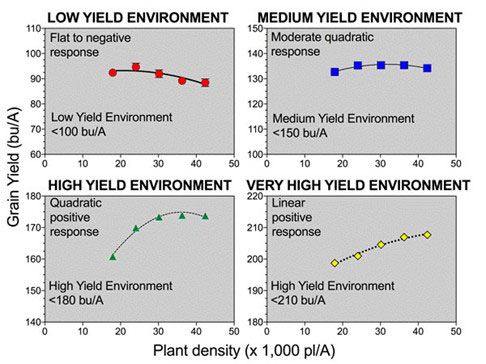
Figure 1. Corn grain yield response to plant density in four yield environments, a) <100; b) 100-150; c) 150-180; and d) > 180-210 bu/acre (Assefa, Ciampitti et al., 2016, Crop Science). Figure created by I.A. Ciampitti, K-State Extension.
As a disclaimer, the “agronomically” optimum plant population does not always match the “economically” optimal plant population. The final seeding rate depends on the genetics (hybrid), the environment, and other production practices (e.g., planting date, crop rotation, tillage). Also, keep in mind that the corn yield response to plant density curves is merely indicative, as they represent simplified models that carry uncertainty (error).
Tina Sullivan, Northeast Area Agronomist
tsullivan@ksu.edu
Logan Simon, Southwest Area Agronomist
lsimon@ksu.edu
Lucas Haag, Agronomist - Tribune
lhaag@ksu.edu
Jeanne Falk Jones, Northwest Area Agronomist
jfalkjones@ksu.edu