Cool-season perennial grasses (CSG), particularly Smooth brome (Bromus inermis) and Tall fescue (Festuca arundinacea), are commonly cultivated as forage species in Kansas. While desirable in pastures managed for cool-season forage, they can also become established and problematic in areas managed as native warm-season grass (WSG) stands. Herbicides are a common tool used to knock back weedy species in pasture and rangeland, but there are only a few herbicides that are effective on grasses, and they come with a high risk of off-target effects to native WSG that are sensitive to the same herbicides.
Luckily, the peak growth periods for WSG and CSG occur at different times of year (Figure 1). We can leverage this difference to apply herbicide and prescribed burning to target weak points in CSG development while reducing or even avoiding off-target impacts to WSG.
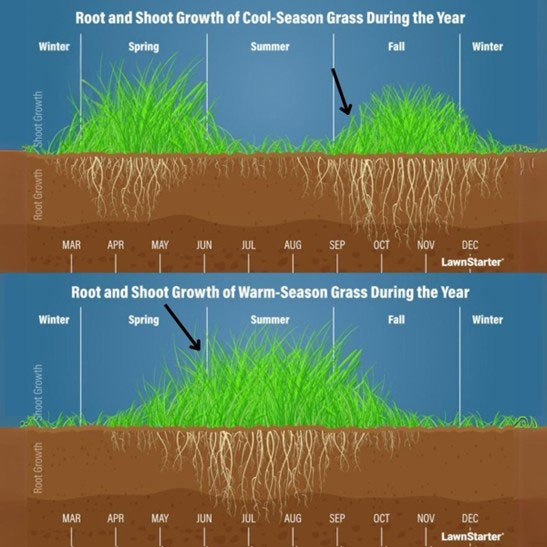
Figure 1. Depiction of the general growth pattern difference between cool-season grasses (CSG, top) and warm-season grasses (WSG, bottom) over the course of the growing season. Figure courtesy of Melanie Joseph/LawnStarter.
Prescribed Burning
Historically, fires occurred in Kansas at an average of every 2 to 10 years. Responses of specific species will vary, but native WSG have evolved with fire and are tolerant of prescribed fire management. While CSG are tolerant of prescribed burning in late winter and early spring (up to ~1/2” growth), burning in the late spring, when they are at peak growth (4-6” growth, typically April and May), has been shown to reduce CSG productivity. Consider repeat burns at this time of the year to reduce CSG in your WSG over time. This approach will also clear off any thatch in your stand that could reduce herbicide uptake by target plants during an application later in the year.
Herbicide Application Timing
When CSG first emerges in the spring, it’s tempting to hit them with herbicide before WSG is active. This approach is not necessarily problematic, but an important window for more effective control emerges as CSG and WSG are going dormant at the end of the season.
Effective control of perennial plant species is highest when we can apply herbicide at a time when target plants will effectively absorb and transport the herbicide down to their root systems. In the spring, plants draw on stored carbohydrate reserves to support aboveground growth. Because plants are “pulling up” during this time, they’re not moving reserves down to their root system and are unlikely to transport any herbicide applied to their foliage down to their roots either. Plants will take damage to their aboveground foliage, but as long as they have more reserves, perennial CSG like smooth brome and fescue will resprout again, even though they get knocked back a bit.
In the fall, both WSG and CSG will move reserves down to their roots as they enter dormancy, but their timing is slightly different, which is key for effective herbicide application at this time. In the week after the first hard frost, WSG has finished this process and is safely dormant for the season. CSG are still actively moving reserves down into their roots for the season, though, which is why this makes for a great window to apply herbicide, and when CSG are likely to transport it to their root systems while avoiding damaging nearby native WSG.
For fall herbicide application, choose a sunny day when daytime temperatures are at or above 50º F. 1-3 qt/acre of 3lb ae/gal glyphosate can be used for both tall fescue and smooth brome control. Refer to the label for the specific glyphosate product you use for any adjuvant requirements to increase efficacy. Plateau for tall fescue (imazapic, 12oz/acre) or Arsenal for smooth brome (imazapyr, 1-2pt/acre) can also be applied at this time, providing residual control into the following year. Plateau persists in the soil for 3-6 months, but keep in mind that Arsenal can persist for approximately a year after treatment and restricts germination of new CSG and WSG from the soil during this time (see 2026 Chemical Weed Control Guide for persistence times).
If you are applying herbicides in the spring, use glyphosate at the above rate to knock back CSG before WSG emerges.
Take Home Message
Regardless of when you apply herbicide, removing thatch from the soil surface through burning, mowing, grazing, etc., can help increase contact before foliar-applied herbicides and with your target species (be sure to allow time for regrowth). If you can combine late spring prescribed fire with fall herbicide application, you can increase the impact of CSG management more than either method alone while minimizing impact to your native WSG.
Molly Reichenborn, Range Management Specialist
mreichenborn@ksu.edu
Tags: pastures tall fescue smooth brome grasses native grasses