Three common brush species native to Kansas and widely spread across the state are buckbrush (Symphoricarpos orbiculatus), roughleaf dogwood (Cornus drummondii), and smooth sumac (Rhus glabra).
Buckbrush is a shrub that can grow to over 6 feet tall with rhizomes and stolons. It has opposite leaves (Figure 1). Flowering occurs in June and July, with red fruit produced in the late summer. Buckbrush occurs in disturbed woodlands, along creek banks, old fields, and on rangelands and pastures.
Roughleaf dogwood is a shrub that can reach 15 feet in height. Flat-topped clusters of white flowers usually appear in late May to early June. The round white fruits appear from September to October. Roughleaf dogwood occurs in fencerows, along the edges of woods, along streams, and on open prairies. It provides cover for wildlife and nesting birds.
Smooth sumac will grow to a height of 5-7 feet and produces an open milo-like head in early June. Leaves are odd-pinnately compound and turn bright red in the fall. The round red fruits are produced from August to September. It grows on rocky soils in pastures and along fencerows. Some birds will eat the seed, and the plants provide cover for birds and mammals.
These shrubs can produce clumps that will shade out and reduce herbaceous forage (grasses, forbs) production. Cattle generally do not browse these species. Sheep and goats are more likely to utilize these woody plants.
Be on the lookout for buckbrush, roughleaf dogwood, and smooth sumac, and implement a control plan if needed.
Buckbrush control
For effective control of buckbrush, consider top removal, or removing aboveground growth, after the plants have leafed out and the nonstructural carbohydrates stored in the roots are at a low level. A single mowing is likely to cause resprouting, so multiple cuttings at the appropriate time (generally early to mid-May) are necessary. Another effective method is prescribed burning for 2-3 consecutive years during the same time frame.
Herbicides can also be used to control buckbrush. The best time to spray occurs after the plants are fully leafed out (Figure 1), but before the leaves are too mature (generally mid-May to early June). A number of herbicides can be used, but 2,4-D low-volatile ester (LVE) formulations at 1.5 to 2 lbs/acre are usually quite effective. Other options include using 2,4-D LVE product in combination with other active ingredients, such as aminopyralid + metsulfuron (Chaparral) at 3 oz/acre mixed with 2,4-D at 2 pt/acre, or as a premix such as Grazon P+D (picloram + 2,4-D) at 2-4 pt/acre. Caution should be used if treating cool-season grasses with Chaparral. Grazon P+D is a restricted-use pesticide. Always read the label when considering the use of herbicides.
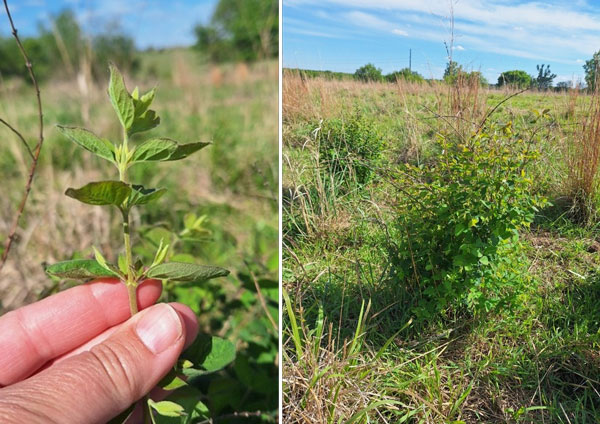
Figure 1. Example of buckbrush leaves growing opposite of each other along branches (left) and overall growth habit of buckbrush (right). Photos by Sarah Ganske, K-State Extension.
Roughleaf dogwood control
Roughleaf dogwood is rarely grazed and invades grassland in the absence of prescribed burning. Pastures that are frequently burned usually do not have a roughleaf dogwood problem. A Konza Prairie study near Manhattan indicated that roughleaf dogwood increases dramatically on grazed or ungrazed watersheds with early spring burning every 4 years compared to annual burning. Once established, roughleaf dogwood is difficult to remove with fire alone as the plant usually leafs out after the burning season. Long-term late-spring burning may gradually reduce stands of roughleaf dogwood.
The optimum time to spray roughleaf dogwood is between the flower bud stage and early seed production (Figure 2). A number of foliar-applied herbicides, including triclopyr (Remedy Ultra), dicamba (Banvel), and picloram (Tordon 22K) used alone or in combination with 2,4-D will defoliate roughleaf dogwood, but actual mortality is usually less than 25%.
Roughleaf dogwood can be difficult to control. High-volume treatments providing greater than 50% mortality include 0.5-1% PastureGard HL (triclopyr + fluroxypyr), 1% Surmount (picloram + fluroxypyr), and 1% Grazon P+D + 0.5% Remedy Ultra (picloram + 2,4-D + triclopyr). All these herbicides are applied with water. Adding a 0.25 to 0.5% v/v non-ionic surfactant may enhance control. Aerial applications should be applied at a rate of at least 3 gallons per acre of total spray solution to ensure adequate coverage.
A single application of any herbicide does not completely eliminate roughleaf dogwood, but may open up the stand enough to carry a fire. In subsequent years, a combination of prescribed burning in the late spring followed by a herbicide application 4-6 weeks post-burning to allow regrowth that is susceptible to herbicide should provide good control.
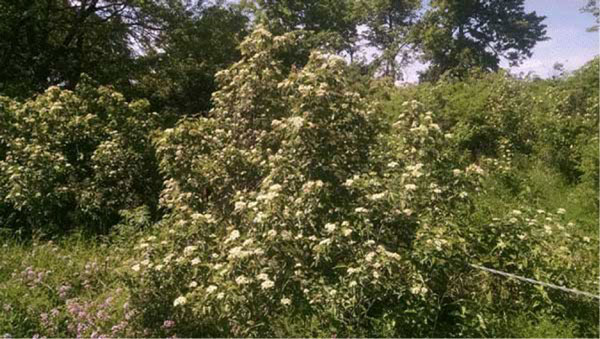
Figure 2. Roughleaf dogwood in full bloom. Photo by Walt Fick (Emeritus faculty), K-State Extension.
Smooth sumac control
Late-spring burning will keep smooth sumac shorter in stature, but generally increases stem density. The optimum time to spray smooth sumac is between the flower bud stage and early seed production (Figure 3). Smooth sumac is among the easiest woody plants to control with herbicides if applied at the proper time. With ground or aerial applications, smooth sumac is controlled with 2-3 pint/acre 2,4-D.
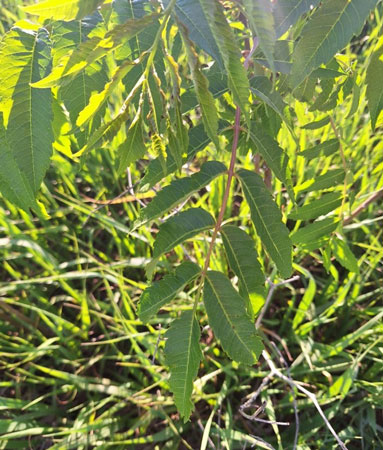
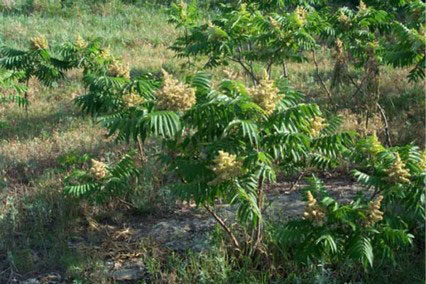
Figure 3. Example of Smooth sumac leaflets (top) and appearance in early seed production stage (bottom). Photos by Sarah Ganske (top) and Walt Fick (bottom), K-State Extension.
Additional measures that can control buckbrush, roughleaf dogwood and smooth sumac
Soil-applied materials such as Spike 20P (tebuthiuron) and Pronone Power Pellets (hexazinone) can provide control of roughleaf dogwood and smooth sumac. Buckbrush is not listed on the Pronone Power Pellets label. Spike 20P should be applied during the dormant season at 0.75 ounces per 100 square feet of product. This is equivalent to 20 pounds of product per acre. Pronone Power Pellets should be applied when the soil is moist and rainfall is expected within 2 weeks of application. For plants 3-6 feet tall, apply 2-4 pellets at the base of the plant. Expect to see grass damage following the use of Pronone Power Pellets and temporary grass yellowing after using Spike 20P pellets.These dry soil-applied products may be useful in areas where spray drift may cause considerable non-target damage. Keep in mind that soil-applied herbicides can be transported downslope in the soil, and the risk of damaging desirable downslope vegetation is increased when these herbicides are not applied following label instructions.
Growing season burns, e.g., in August, also have the potential to reduce stands of roughleaf dogwood and smooth sumac.
The use of trade names is for clarity to readers and does not imply endorsement of a particular product, nor does exclusion imply non-approval. Always consult the herbicide label for the most current use requirements. Users should read and follow all label directions.
Molly Reichenborn, Range Management Extension Specialist
mreichenborn@ksu.edu
Sarah Ganske, Weed Management Extension Specialist
slancaster@ksu.edu
Tags: herbicide brush control smooth sumac buckbrush roughleaf dogwood