A strong ridge of high pressure brought intense heat to the southwest and south central United States, including Kansas, this past week. Temperatures more reminiscent of mid-summer than early spring resulted in numerous daily and monthly record highs across the state. In this article, we take a look at some of the records and the rarity of such an event.
Rapid Warm-Up and Daily Temperature Records
The onset of the heat was quite rapid. Back on the 16th, the average daily high across the Kansas Mesonet was a chilly 41°F. In the next five days, the average high increased: 63°, 81°, 87°, 91°, and finally a scorching 95° on the 21st, some 35 degrees above normal for the date. A few daily record highs were set prior to the 21st, but it was on the last day of this stretch that the most records were set. In the following review of records, we focus only on observing sites with at least 50 years of historical climate data. There are over 100 such sites in Kansas.
First, let’s start with the daily records set on March 21 (note: the highs on March 21 appear in the March 22 climate report of co-operative sites, where a 7 AM-7 AM day is used; that convention has been taken into account to compare the high reached on the afternoon of the 21st with its corresponding record). Over 60 new record highs were set for the date by an average of over 6 degrees. Fifteen sites set new records by at least ten degrees, led by Pittsburg, where the high of 91° was a new record by an amazing 15 degrees!
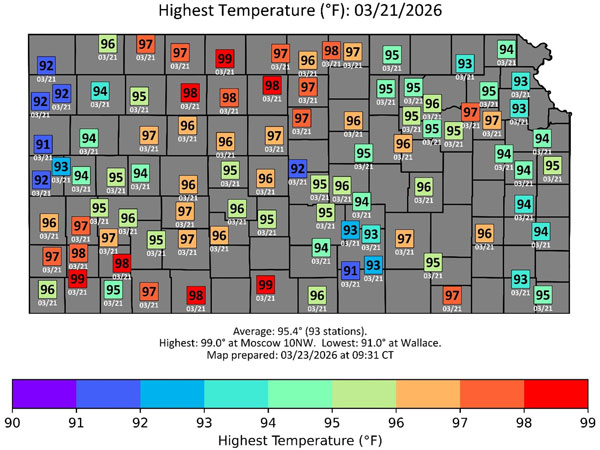
Figure 1. The highest temperature recorded at each Kansas Mesonet site on March 21, 2026.
Even more impressive, there were 64 new record highs for March set on the 21st. Melvern Lake and Atwood’s highs had the largest margin of victory, each setting new monthly marks by eight degrees. Four locations in Kansas reached 100 degrees, an incredibly rare feat for March. Prior to this month, a high of 100° in March had happened only once: way back on March 21, 1907, at Ashland. Of the four highs this year, one station, Plainville, made it to 101°, and in the process set Kansas’ new record for March. The other three sites to reach 100° were Webster Dam, Atwood, and Sedan. For the latter two locations, reaching 100° this early in the year is unprecedented. This was Atwood’s earliest 100-degree day by 45 days; the old record was May 6. Even more impressive, the 100° high at Sedan set a new record for the earliest 100-degree reading by more than 2 months; the old record was May 31st. Not only did Sedan set a new record for March, but this mark is also higher than the record high for April (99°) and equal to the record high for May as well!
Not all stations managed a record high, as the aforementioned 1907 played spoiler. Prior to this month, there were 27 record highs for the month of March set that year. A total of 19 of those are still standing after this year’s heat event. The seven locations where the 2026 high bested their 1907 marks were Burr Oak (98°), Chapman (96°), Goodland (92°), McPherson (95°), Osage City (96°), Salina (97°), WaKeeney (96°), and Yates Center (97°). Three additional sites tied their monthly records from 1907: Greensburg (95°), Healy (97°), and Manhattan (95°).
Extreme Temperature Swings
The Kansas Mesonet did not record any triple-digit temperatures during the event, but three locations were very close. The Stevens, Phillips and Barber County Mesonet sites all peaked at 99° (Fig. 1). These three sites, and at least 40 others, all exceeded the Mesonet’s previous record high for March: 96° set at three locations on March 19, 2017. Historical Mesonet data dates back to 1985. A few Mesonet sites in western Kansas experienced both winter and summer last week, with temperature swings between the 16th and 21st of over 90 degrees. The largest swing was at the Stevens County site: 93 degrees, between a low of 6° on the 16th and a high of 99° on the 21st.
The Bigger Climate Picture
Thanks to this hot spell and above-normal temperatures earlier this month, March is almost certain to be the seventh consecutive above-normal month, a string that began last September. It’s unlikely that March 2026 will finish as the warmest March on record, a spot currently held by 2012 (average temperature 55.5°). A top 10 finish is quite possible, depending upon how the last week of the month plays out. The current outlook for the remainder of March favors above normal temperatures, so a high ranking is likely. For the record, 1907 ranks as the 6th warmest March on record (50.5°).
Kansas was one of many states to experience record heat this past week. Preliminary data from the National Centers for Environmental Information indicate that over 500 new monthly records were set. A few of these from neighboring states include: 86° at Denver and Colorado Springs, CO, 97° at Lincoln and Hastings, NE, 93° at Kansas City, MO, and 97° at Ponca City, OK. Hotter still, four locations in Arizona and California reached 112°, the United States’ new record high for the month of March.
Matthew Sittel, Assistant State Climatologist
msittel@ksu.edu